Tire Expiration Date: The 6-Year Rule, DOT Date Code Reading & Rubber Aging Physics
Checking your tire expiration date is one of the most neglected life-saving vehicle inspections. Millions of motorists drive on tires with deep, brand-new tread depths without realizing that the underlying rubber compound expired years ago. Vulcanized rubber oxidizes silently from the inside out, turning flexible structural polymers into brittle glass. Here is how to decode the 4-digit Department of Transportation (DOT) date code, why the 6-year replacement rule exists, and how to prevent catastrophic highway tread separation.
Interactive DOT Tire Date Code Decoder & Aging Risk Calculator
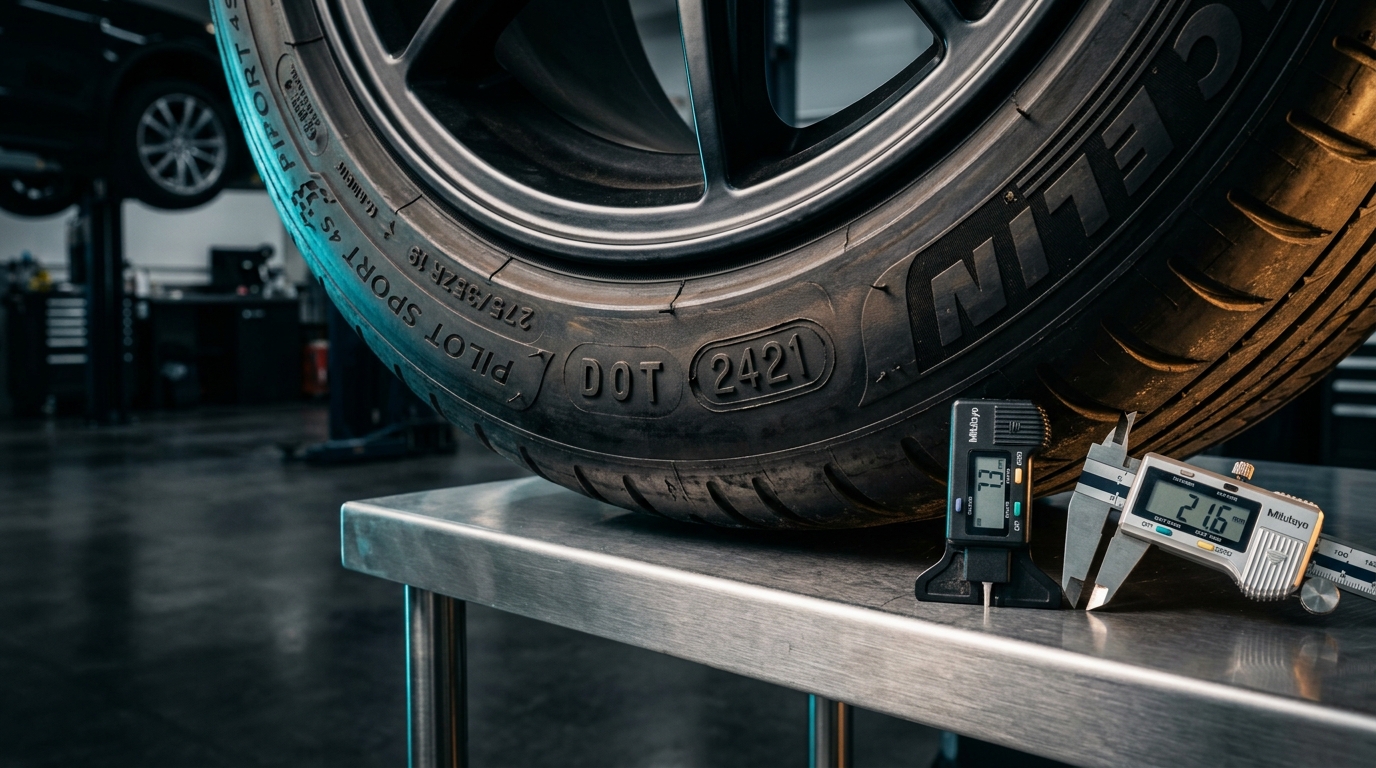
Calculate your tire’s exact age in seconds: type the 4-digit serial code from your tire’s sidewall oval (e.g. 2421) or select a preset button below. Observe real-time rubber oxidation levels, highway thermal capacity derating, and official NHTSA safety verdicts live.
Manufactured 24th week of 2021. Approaching mandatory 6-year safety limit.
Plasticizing volatile oils evaporating. Tread blocks hardening under thermal cycling.
Internal steel belt skim stock suffering rubber-to-metal chemical debonding.
Inspect groove bottoms for hairline ozone checking. Replace within 6–12 months.
- Interactive DOT Tire Date Code Decoder & Aging Risk Calculator
- What Is a Tire Expiration Date? (DOT Decoding 101)
- The 6-Year vs 10-Year Replacement Rule: Why Tread Depth Lies
- The Chemistry of Rubber Oxidation: Why Old Tires Delaminate
- Spare Tires, RVs & Trailers: The Silent Highway Time Bomb
- How to Inspect Tires for Age Damage: Crazing & Weather Checking
- Frequently Asked Questions About Tire Expiration Dates
During a fatal rollover highway accident investigation in Texas, state accident reconstructionists inspected a commercial passenger SUV that had suffered catastrophic rear tire tread separation at 72 mph. The driver had recently bought the vehicle used from an independent dealer who proudly advertised "Brand New Tires."
When investigators pressed a digital depth gauge into the remaining grooves, it read a healthy 9/32-inch—nearly 90% of factory tread life remaining. But when they examined the embossed oval on the inner sidewall, the serial code read DOT 3414.
At sustained interstate speeds, the internal bonding between the steel belts and the vulcanized rubber skim stock disintegrated. The tread belt peeled completely off the carcass in milliseconds. Understanding your vehicle's tire expiration date is not an aesthetic concern—it is the difference between safe travel and catastrophic mechanical failure.
What Is a Tire Expiration Date? (DOT Decoding 101)
Unlike a carton of milk or a pharmaceutical bottle, pneumatic passenger tires do not stamp a traditional calendar "best by" date onto their rubber. Instead, regulatory frameworks established by the National Highway Traffic Safety Administration (NHTSA) and the Department of Transportation mandate that every road-legal tire carry a standardized Tire Identification Number (TIN) stamped directly into the sidewall.
The true tire expiration date is derived from the final four numerical digits of this serial code, which is always enclosed inside an embossed oval depression:
📅 First 2 Digits: Week of Manufacture
The first two digits represent the specific calendar week of the manufacturing year, ranging from 01 (the first week of January) to 52 (the final week of December). For example, "24" indicates the third week of June.
🗓️ Last 2 Digits: Year of Manufacture
The final two digits denote the exact calendar year. A stamping of "21" indicates 2021, while "26" indicates 2026. Prior to the year 2000, tires used a 3-digit code (e.g. "249" meant week 24 of 1989 or 1999).
⚠️ Crucial Inspection Note
Tire manufacturers often stamp the full 10-to-12 character TIN on only one side of the tire (typically the outboard face). If you see "DOT U2 LL LMLR" without a 4-digit number at the end, crawl underneath or check the inboard sidewall face.
Need to cross-reference other sidewall specifications like aspect ratio, load rating, or speed symbols? Review our complete guide to reading tire sidewall numbers and markings.
Replacing Aged or Weather-Checked Tires?
Calculate exact rolling circumference, rim width clearance, and speedometer variance using our 3D interactive comparison calculator.
The 6-Year vs 10-Year Replacement Rule: Why Tread Depth Lies
The most dangerous misconception in automotive maintenance is assuming that a tire is safe simply because it has not reached the legal 2/32-inch wear bar indicator. While mechanical tread wear is governed by friction against asphalt, chemical aging happens continuously—even when a vehicle sits parked inside a dark garage.
To protect motorists, major global tire manufacturers and safety bodies enforce two distinct chronological replacement benchmarks:
| Tire Age Threshold | Physical Status | Safety Recommendation | Authority Source |
|---|---|---|---|
| 0 to 3 Years | Prime Elasticity | Optimal Safety • Routine 6,000-mile tire rotations | OEM Factory Standard |
| 3 to 5 Years | Gradual Oxidation | Normal Commuter • Inspect tread depth & PSI monthly | TIA / RMA |
| 5 to 6 Years | Plasticizer Depletion | Annual Inspection • Professional dismount & internal check | Michelin / Continental |
| 6 Years (Strict) | Oxidative Brittleness | Mandatory Replacement for hot climates, spares & light trucks | NHTSA / Ford / BMW / Toyota |
| 10 Years (Absolute) | Structural Delamination Risk | Scrap Immediately • Unsafe for road travel under any condition | Global Tire Industry Consensus |
Why do vehicle manufacturers like Ford, General Motors, BMW, and Toyota recommend replacing tires at 6 years of age regardless of tread wear, while tire makers like Michelin and Continental state an absolute ceiling of 10 years?
The answer lies in risk mitigation. Vehicle manufacturers know that under real-world conditions—such as driving in hot southern climates, encountering road chemicals, and carrying heavy passenger loads—the probability of catastrophic steel belt separation escalates dramatically between years 5 and 7. Tire manufacturers allow up to 10 years only if the tire receives mandatory, rigorous annual inspections by a certified technician dismounting the rubber to inspect internal casing ply bonds.
The Chemistry of Rubber Oxidation: Why Old Tires Delaminate
To understand why a tire expires, you have to examine polymer chemistry. A modern passenger tire is not a single piece of vulcanized rubber; it is a sophisticated composite structure composed of synthetic butadiene, natural tree latex, carbon black, silica, polyester cords, and brass-plated high-tensile steel belts.
When a tire is manufactured, volatile aromatic oils, antioxidants, and wax-like anti-ozonants are blended into the compound. As you drive, the centrifugal flex of the rotating sidewall forces these protective chemical waxes to migrate continuously to the surface, creating an invisible shield against atmospheric oxygen and solar ultraviolet (UV) radiation.
🧪 1. Volatile Plasticizer Evaporation
Over 5 to 6 years, the volatile oils that keep rubber supple evaporate into the atmosphere. The flexible cross-linked polymer chains cross-link excessively, transforming pliable rubber into a rigid, glass-like substance that cannot flex under road impacts.
⚡ 2. Ozone Attack & Free Radical Oxidation
Ambient ozone ($O_3$) generated by vehicle exhaust and electrical transformers attacks the unsaturated double bonds in the rubber molecules. This scission breaks long polymer backbones into short, brittle fragments, manifesting as visible sidewall dry rot.
🔥 3. Steel Belt Skim Stock Delamination
Atmospheric oxygen migrates through the porous innerliner of the tire from the pressurized air inside. This oxygen oxidizes the specialized "skim rubber" that bonds the high-tensile steel belts to the tire carcass. Under highway heat, the steel belts peel away from the casing.
⚠️ The Hot Climate Multiplier: Why Tires Age 200% Faster in the Sunbelt
Scientific studies conducted by the Society of Automotive Engineers (SAE) demonstrate that ambient thermal stress accelerates rubber oxidation exponentially. Tires operating in states like Arizona, Texas, Florida, and Nevada age at more than double the rate of tires driven in northern states. In hot regions, a tire can reach critical internal embrittlement in just 4 to 5 years.
Spare Tires, RVs & Trailers: The Silent Highway Time Bomb
The single most common source of expired tire blowouts involves vehicles that are driven infrequently: recreational vehicles (RVs), boat trailers, horse trailers, utility haulers, and the full-size spare tire mounted beneath pickup trucks.
Motorists frequently inspect an RV tire or a trunk spare, see 10/32-inch of pristine, unblemished tread, and assume the vehicle is ready for a cross-country family road trip. This is a deadly mistake.
- Zero Wax Migration: Because spare tires and parked RVs do not flex and rotate daily, the protective anti-ozonant waxes remain trapped deep inside the rubber matrix. The outer sidewall receives zero chemical replenishment, allowing atmospheric ozone to dry out the casing unimpeded.
- Undercarriage Thermal Baking: Full-size pickup and SUV spare tires mounted beneath the rear chassis are constantly baked by exhaust tailpipe heat, drenched in road salt, and pelted with road gravel. A 7-year-old spare tire can experience structural failure within 15 miles of being installed.
- Trailer Dynamic Overheating: Trailer tires typically operate near their maximum load rating and utilize stiffer carcasses. When an aged, oxidized trailer tire flexes at 65 mph, internal heat climbs above 180°F, triggering instantaneous belt detachment.
Planning to replace a set of trailer or passenger tires on a budget? Consult our comprehensive discount tires buyer's guide to ensure you never purchase old warehouse stock.
How to Inspect Tires for Age Damage: Crazing & Weather Checking
In addition to decoding the 4-digit DOT date code, every motorist should perform a tactile and visual inspection of their tire rubber every 6 months:
- Inspect Circumferential Groove Valleys: Turn your steering wheel to full lock to expose the tire tread face. Use a bright LED flashlight to examine the bottom channel where the tread blocks meet the casing. If you observe fine, spiderweb-like hairline cracks (crazing), the rubber has oxidized and lost its elasticity.
- Check Sidewall Shoulder Radii: Examine the curved transition zone between the tread shoulder and the smooth sidewall. Deep radial cracks exceeding 1 mm in depth indicate severe ozone dry rot. The tire must be retired immediately.
- Tactile Hardness Test: Press your thumbnail firmly into a tread block. Fresh, healthy tire rubber will yield pliantly and rebound instantly. If the rubber feels hard like bowling ball plastic and chips or flakes under thumb pressure, the polymer oils have vanished.
- Listen for High-Speed Steering Flutter: If an aged tire develops an internal belt separation, it will produce a rhythmic low-frequency wobble or steering vibration that intensifies between 45 and 65 mph before the tread delaminates completely.
Frequently Asked Questions: Tire Expiration Dates
Can I legally drive on tires older than 6 or 10 years?
In the United States and most jurisdictions, there is currently no federal law prohibiting motorists from driving on aged tires, provided the tread depth remains above the legal 2/32-inch minimum and no cords are exposed. However, insurance adjusters frequently deny collision claims or assign contributory negligence if an accident was triggered by the blowout of an expired 10+ year-old tire with visible dry rot.
Is it legal for tire shops to sell 3 or 4-year-old "new" tires?
Yes. Many tire retailers store inventory in warehouses for several years before selling it as "new." While tires stored in climate-controlled warehouses age slower than tires exposed to sunlight, their chemical expiration clock is still ticking. Always inspect the 4-digit DOT date code before purchasing or having new tires mounted; never accept tires manufactured more than 12 to 18 months prior.
Does tire dressing or shine protect rubber from dry rot?
Actually, petroleum-based tire dressings and silicone sprays can accelerate rubber degradation. Petroleum distillates wash away the natural protective waxes and anti-ozonants embedded inside the rubber compound, leaving the casing more vulnerable to environmental ozone attack. Clean your tires with mild car wash soap and water only.
How should I store seasonal winter or track tires to prevent aging?
Store dismounted seasonal tires clean, dry, and sealed inside opaque, airtight plastic bags (such as heavy-duty lawn contractor bags). Keep them in a cool, dry, dark environment away from direct sunlight, electric motors, furnaces, and welding equipment, which emit rubber-degrading ozone gas. Cross-reference seasonal fitments with our All-Season vs All-Weather vs Winter Tires Guide.