Run-Flat vs. Conventional Tires: Sidewall Reinforcement, Highway Punctures & Replacement Costs
 By Bilal Khan · Lead Automotive Fitment Researcher · TiresTreads.com · Published: October 2026
Comparing run-flat vs conventional tires is one of the most important safety and fitment decisions for modern drivers. Luxury brands often fit run-flats to free trunk space; many owners later question ride comfort and replacement cost. This guide explains the engineering: self-supporting sidewalls, puncture behavior on the highway, and what really changes if you switch back to standard rubber.
Interactive Sidewall Collapse & Puncture Simulator
Switch between a conventional pneumatic tire and a reinforced run-flat (RFT), then drop the pressure to see how sidewall rigidity limits rim drop after a puncture.
Internal Inflation Pressure:
35 PSIHighway Drivability
100% Road ReadyTire maintains normal rolling circumference. Full highway speed safe.
Wheel Rim Protection
Full Clearance (5.5″)Alloy barrel is well buffered from asphalt impact.
Spare Tire Requirement
Standard Spare / KitVehicle requires either a trunk spare, jack, or roadside assistance plan.
Ride Comfort & Weight
Plush & CompliantLightweight flexible sidewalls absorb sharp road joints with minimal harshness.
Table of Contents: Sidewall Construction & Safety Guide
At 11:30 PM on a rain-soaked four-lane highway, a friend of mine ran over a stray steel bracket from a flatbed truck. His passenger-side dashboard chimed with a TPMS warning. Within ten seconds, pressure fell from 34 PSI to zero.
On conventional tires, he would have been forced onto a narrow, unlit shoulder with trucks passing at 70 mph, working a scissor jack in the dark.
That is the main virtue of run-flat engineering: a roadside emergency becomes a controlled drive to safety. That peace of mind still comes with clear compromises in comfort, weight, and cost.
How Self-Supporting Sidewalls Work: Structural Insert Physics
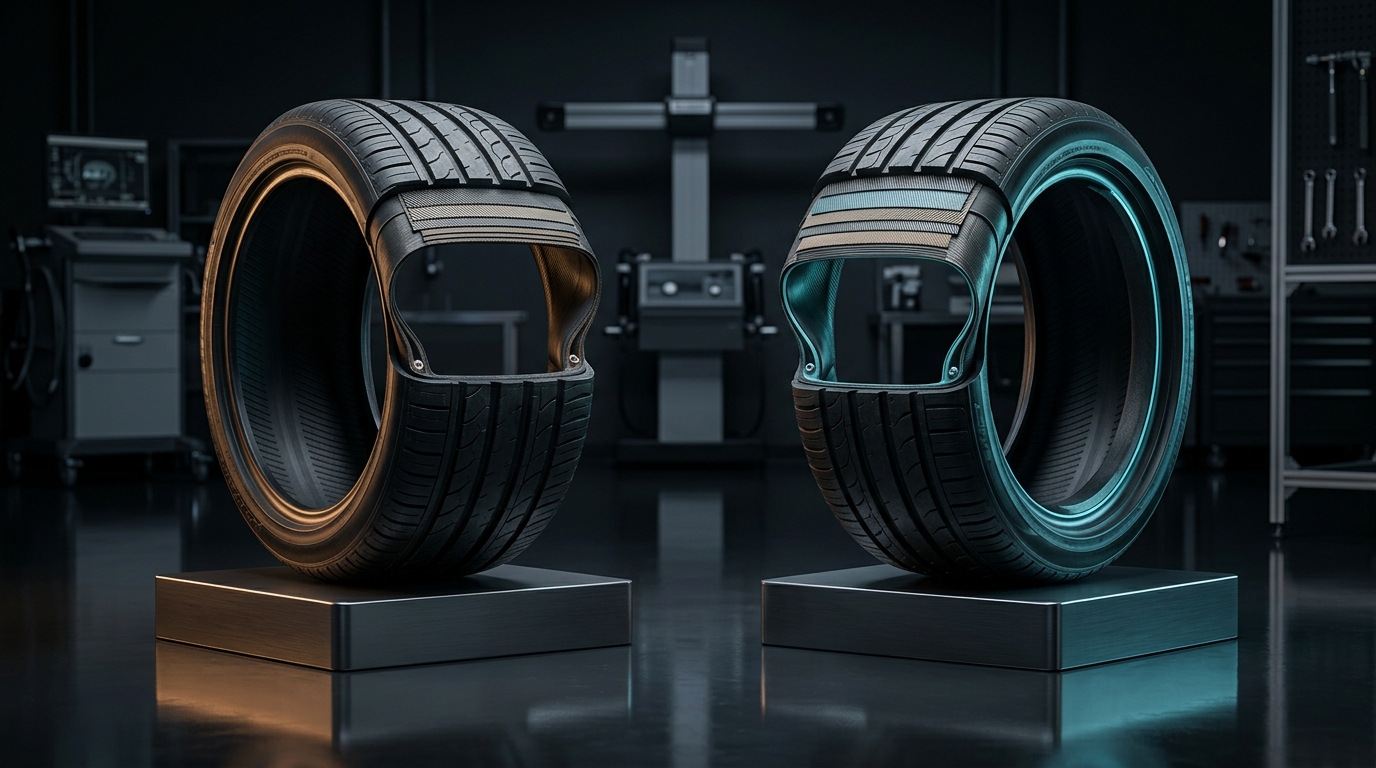
Most OEM run-flats on modern BMW, Mercedes-Benz, Lexus, and Mini vehicles use self-supporting run-flat (SSR) construction. The difference from standard tires is structural reinforcement in the sidewall—not a different way of “holding air.”
In a conventional pneumatic tire, the flexible sidewall is mainly a protective envelope. Pressurized air carries the vehicle load under NHTSA tire safety guidance and industry practice from groups such as SAE International. When air escapes, the rim drops and pinches the folded rubber against the road.
Run-flats embed thick, heat-resistant rubber inserts in the sidewall carcass. After total pressure loss:
- Mechanical support: Dense inserts help carry the car so the aluminum rim does not slam into the pavement.
- Bead retention: Bead design helps keep the tire on the rim during low-speed cornering while deflated.
- The 50/50 guideline: Many makers rate mobility up to about 50 miles (80 km) at up to 50 mph (80 km/h) when fully deflated—always follow the tire’s own limit.
Head-to-Head Comparison Matrix: Performance, Durability & Cost
Choosing factory run-flats or switching to traditional tires means clear trade-offs in safety, comfort, and ownership cost:
| Engineering Factor | Conventional Tires | Self-Supporting Run-Flat (RFT) |
|---|---|---|
| Puncture safety | Rim drop risk; roadside change or tow often required | Better stability; often drive a limited distance to a shop |
| Ride comfort | More compliant over seams and joints | Firmer; stiff sidewalls transmit more harshness |
| Weight per corner | Baseline (often ~20–25 lb class, size-dependent) | Often several pounds heavier due to inserts |
| Purchase price | Standard market pricing | Often ~25–40% higher for equivalent size |
| Repairability | Center-tread punctures often patchable per shop policy | Many shops refuse repair after zero-pressure miles |
| Trunk space | Space needed for spare/jack or inflator kit | Can free under-floor space (no spare packages) |
Why Drivers Switch to Standard Rubber: Ride Quality & Economics
Despite puncture mobility, many luxury owners choose conventional rubber at replacement time. Common reasons:
Ride harshness
Sidewalls built to stand at zero PSI flex less over potholes and bridge seams. On large 19–20 inch wheels the cabin can feel sharper.
Extra unsprung weight
Added rubber per corner increases rotational mass. Suspensions work harder; response can feel a bit duller.
Harder puncture economics
A conventional tire with a simple center nail is often repaired cheaply. A run-flat driven flat may be scrapped because internal heat damage is hard to inspect.
Wear and pressure discipline
Stiffer shoulders can wear outer blocks faster under aggressive cornering. Keep cold pressures correct—see our tire pressure guide and conversion chart.
Transitioning to Standard Rubber: Critical Spare Tire Protocols
You can usually mount conventional tires on wheels that came with run-flats when size, load index, and speed rating match. Rim bead geometry is typically compatible. Prepare for three practical issues:
The missing spare trap
Many run-flat OEM cars (for example some BMW 3/5 Series packs) ship with no spare, no jack, and no lug wrench. If you switch to conventional tires, plan for:
- A compact spare kit and jack, or
- A 12V inflator plus quality sealant for temporary mobility, and/or
- A roadside assistance membership
Switching sizes or rim diameters?
Keep overall diameter close to factory so speedometer and ABS calibration stay honest.
Frequently Asked Questions
How do I know if I have run-flats?
Read the sidewall: Continental SSR, Michelin ZP, Bridgestone RFT, Pirelli Run Flat, Goodyear ROF, and similar marks. See our sidewall markings guide and speed rating & load index chart.
Can I mix run-flats and conventional tires?
Do not mix types on the same vehicle if you can avoid it. Different sidewall stiffness and slip angles can upset stability control. Check wear with our wear diagnostics guide.
Do run-flats need TPMS?
Yes. A run-flat can look almost normal when empty. Without working TPMS you might drive too far or too fast on a deflated tire and overheat the structure.
Does switching void the vehicle warranty?
Proper size, load, and speed rating usually does not void the powertrain warranty. Tire-related noise or suspension complaints may be treated differently by dealers. For shopping tips, see our discount tires guide.