Tire Pressure Dynamics: Cold vs. Hot PSI, Temperature Swings & Why 5 PSI Changes Everything
 By Bilal Khan • Lead Automotive Fitment Researcher • TiresTreads.com • Published: October 2026
Most drivers only check tire pressure when an amber horseshoe light flashes on their dashboard. But tire pressure isn’t static—it breathes with ambient weather, highway speeds, and friction heat. In this engineering guide, we break down the critical science of tire pressure cold vs hot, explain the 10-degree thermal rule, and reveal why a 5 PSI difference dramatically alters vehicle braking distance, fuel economy, and blowout risk.
Interactive Tire Pressure & Contact Patch Simulator
Adjust baseline cold pressure, slide ambient weather temperature from -10°F to 110°F, and toggle highway driving to watch live thermal PSI expansion and contact patch deformation.
Baseline Placard Spec: 35 PSI
Outside Ambient Temp: 70°F (21°C)
Tire Pressure Condition
Optimal Cold PressureContact patch is completely flat across the pavement. Maximum traction and uniform wear.
Fuel Economy Penalty
0% Efficiency LossMinimal rolling resistance against asphalt. Engine runs at peak highway MPG efficiency.
Tread Wear Diagnostic
Even Face WearTread will achieve its full 50,000+ mile warranty lifespan with regular rotations.
Highway Blowout Risk
Very Low (<2%)Sidewalls maintain structured pneumatic rigidity without dangerous hysteresis heat buildup.
Table of Contents: Inflation Dynamics & Pressure Engineering
A few years back, an acquaintance pulled up to my garage frustrated with his tire wear. He had bought a premium set of highway touring tires just 14 months earlier, and both outer shoulders were completely shredded down to the secondary rubber layer, while the center tread still looked brand new.
"I keep them at 35 PSI religiously!" he insisted.
We checked his tires the next morning after they had sat parked cold overnight. His true cold reading wasn't 35 PSI—it was 30.5 PSI, exactly 4.5 PSI below his vehicle's door-jamb placard specification. Because he had only ever checked pressure hot immediately after highway driving, he had been driving chronically under-inflated without realizing it.
Why Cold PSI Is the Universal Automotive Standard
When evaluating tire pressure cold vs hot, every vehicle manufacturer prints a tire specification placard located on the driver-side door jamb. That number (commonly 32 to 36 PSI for passenger cars) specifies Cold Tire Inflation Pressure. According to official NHTSA Tire Safety Guidelines, maintaining recommended cold inflation pressure prevents abnormal tire wear, enhances fuel economy, and significantly reduces rollover and blowout risks.
What does "Cold" actually mean in engineering terms? It does not mean freezing winter weather. A tire is technically cold when the vehicle has been stationary for at least 3 hours, or driven for less than 1 mile at low city speed.
Inside your tire, air molecules follow basic thermodynamics. As your tire rolls along the pavement, the continuous flexing of the rubber sidewalls and the mechanical friction between the tread blocks and the asphalt generate internal thermal energy.
After 20 to 30 minutes of highway driving at 65–75 mph, the internal air temperature inside the tire cavity rises by 40°F to 60°F above ambient room temperature. Under this thermal load, internal pressure naturally spikes by 3 to 5 PSI.
The Pressure Bleeding Fallacy: Why You Must Never Vent Hot Tires
Never let air out ("bleed") of a hot tire because the pressure reads 38 PSI instead of 34 PSI. Vehicle engineers already designed the tire to tolerate this expansion. If you bleed air while hot, the tire will be severely under-inflated once it cools down.
The Morning Gauge Baseline: Measuring Before Solar Heat Absorption
Always measure tire pressure first thing in the morning before the sun beats down on the tires and before you pull out of your driveway. Direct sunlight can increase pressure on one side of your vehicle by 2–3 PSI before you even turn the key.
Thermal Ambient Fluctuations: The 1 PSI per 10°F Principle
When autumn transitions to winter and overnight temperatures plummet from 75°F to 25°F, your tires lose roughly 5 PSI overnight without leaking a single molecule of air. That is why TPMS lights flood dashboard displays on the first freezing morning of the year. For sub-zero safety rules, review our All-Season vs All-Weather vs Winter Guide.
Under-Inflation vs. Over-Inflation: Wear Diagnostics & Contact Patch Deformation
Your tire's air pressure acts as the pneumatic skeleton that supports your vehicle's gross vehicle weight rating (GVWR). When analyzing tire pressure cold vs hot, improper inflation deviates from the chassis engineer's specification, and the geometry of the tire contact patch deforms:
| Pressure State | Contact Patch Shape | Primary Wear Location | Braking & Handling Impact | Fuel Economy Penalty |
|---|---|---|---|---|
| Proper Cold Spec (32–35 PSI) | Uniform rectangular contact patch | Even wear across face | Optimal grip, responsive steering, lowest stopping distance | Baseline (100% efficient) |
| Under-Inflated (-5 to -8 PSI) | Center caves upward; load rests on outer edges | Both outer shoulders bald | Sluggish steering response, extreme sidewall heat buildup, hydroplaning risk | Degrades 1.5% to 2.5% (rolling resistance penalty) |
| Over-Inflated (+6 to +10 PSI) | Center crowns outward; edges lift off road | Center tread ring bald | Harsh ride, jarring suspension crashes, reduced emergency wet grip | Negligible gain, high puncture risk |
The Physics of Highway Blowouts: Hysteresis & Structural Heat Buildup
Many drivers assume that tire blowouts are caused by over-inflation. In reality, real-world evaluations of tire pressure cold vs hot reveal that the overwhelming majority of catastrophic highway tire failures are caused by chronic under-inflation.
When a tire has insufficient internal pressure, the sidewalls undergo excessive cyclic flexing with every full revolution. In polymer engineering, this phenomenon is called hysteresis—the conversion of mechanical strain into pure thermal energy.
At 75 mph, an average passenger car tire rotates roughly 800 times every single minute. An under-inflated sidewall that flexes 800 times a minute rapidly generates internal temperatures exceeding 200°F (93°C). Engineering tests published by SAE International confirm that excessive cyclic sidewall deflection from under-inflation is the leading mechanical cause of casing delamination on highway corridors.
Eventually, this extreme heat breaks down the chemical vulcanization bonds holding the internal steel cords, polyester plies, and rubber casing together. The tread separates from the carcass, causing an explosive highway blowout. To diagnose wear patterns early, reference our Tire Wear Diagnostics Guide.
Check Your Tread Depth & Wet Safety Margins
Proper air pressure and healthy tread depth work together. Use our live 3D caliper simulator to inspect remaining rubber height and wet stopping distance.
Placard PSI vs. Maximum Sidewall PSI: Structural Safety Limits Explained
One of the most dangerous DIY mistakes motorists make when inspecting tire pressure cold vs hot is reading the pressure molded directly onto the tire's rubber sidewall.
Critical Safety Warning: Never Inflate to the Maximum Sidewall Rating
When you inspect your tire sidewall and see embossed lettering reading "MAX 44 PSI" or "MAX 50 PSI", that is NOT the recommended driving pressure. That number represents the absolute maximum cold pressure the tire casing can safely contain at its maximum rated load index.
Always inflate your tires to the specific pressure listed on your Driver’s Door B-Pillar Placard or Owner’s Manual. That pressure was engineered specifically for your vehicle’s axle weight distribution, suspension damping, and ABS braking algorithms.
If you're unsure how to decode the various service descriptions and load ratings embossed on your tire, review our complete Tire Sidewall Numbers & Markings Guide and cross-reference load indices with our Speed Rating & Load Index Chart.
Nitrogen vs. Compressed Atmospheric Air: The Empirical Truth
Dealerships and specialty tire shops frequently offer "Nitrogen Tire Inflation" packages for $50 to $100, claiming better fuel economy and zero pressure loss. A persistent debate in tire pressure cold vs hot maintenance is whether nitrogen inflation eliminates temperature fluctuations. What does engineering data actually tell us?
Standard atmospheric air is already composed of 78% Nitrogen, 21% Oxygen, and 1% trace gases. Nitrogen gas exhibits a slightly slower diffusion rate through vulcanized rubber compared to oxygen, meaning a nitrogen-filled tire generally loses pressure at a marginally slower pace over several months.
- The Real Benefit: Moisture Elimination. Pure industrial nitrogen is completely dry. Regular garage air compressors that lack inline moisture desiccators pump moisture into the tire cavity. At highway operating temperatures, water vapor expands unpredictably, causing wider pressure fluctuations. This is why racing series and commercial aviation utilize dry nitrogen to prevent pressure spikes caused by moisture boiling inside the wheel cavity at extreme brake rotor temperatures.
- The Daily Commuter Reality: For standard road driving, checking your regular compressed air pressure once a month with a $15 digital gauge delivers 99% of the benefits of nitrogen without paying dealership markup. If your tires are plus-sized or low-profile, maintaining exact PSI matters far more than the gas blend inside—read our Wheel Plus Sizing Guide and use our tire conversion chart for low-profile pressure tips.
Frequently Asked Questions: Tire Pressure Dynamics
Why does tire pressure cold vs hot fluctuate by 3 to 5 PSI?
Friction between tread rubber and pavement, combined with continuous sidewall flexing, transfers thermal energy into the tire air cavity. By Gay-Lussac's gas law, rising internal temperature directly raises pressure by approximately 1 PSI for every 10°F of temperature increase.
Why did my TPMS light come on in the morning and turn off in the afternoon?
During cold mornings, low ambient temperatures drop your tire pressure right below the TPMS warning threshold (typically 25% below factory spec). As the afternoon sun warms the air and you drive, tire friction heats the internal cavity back above the threshold, turning the light off. Your tire is still chronically under-inflated and needs air added cold.
What kind of tire pressure gauge is most accurate?
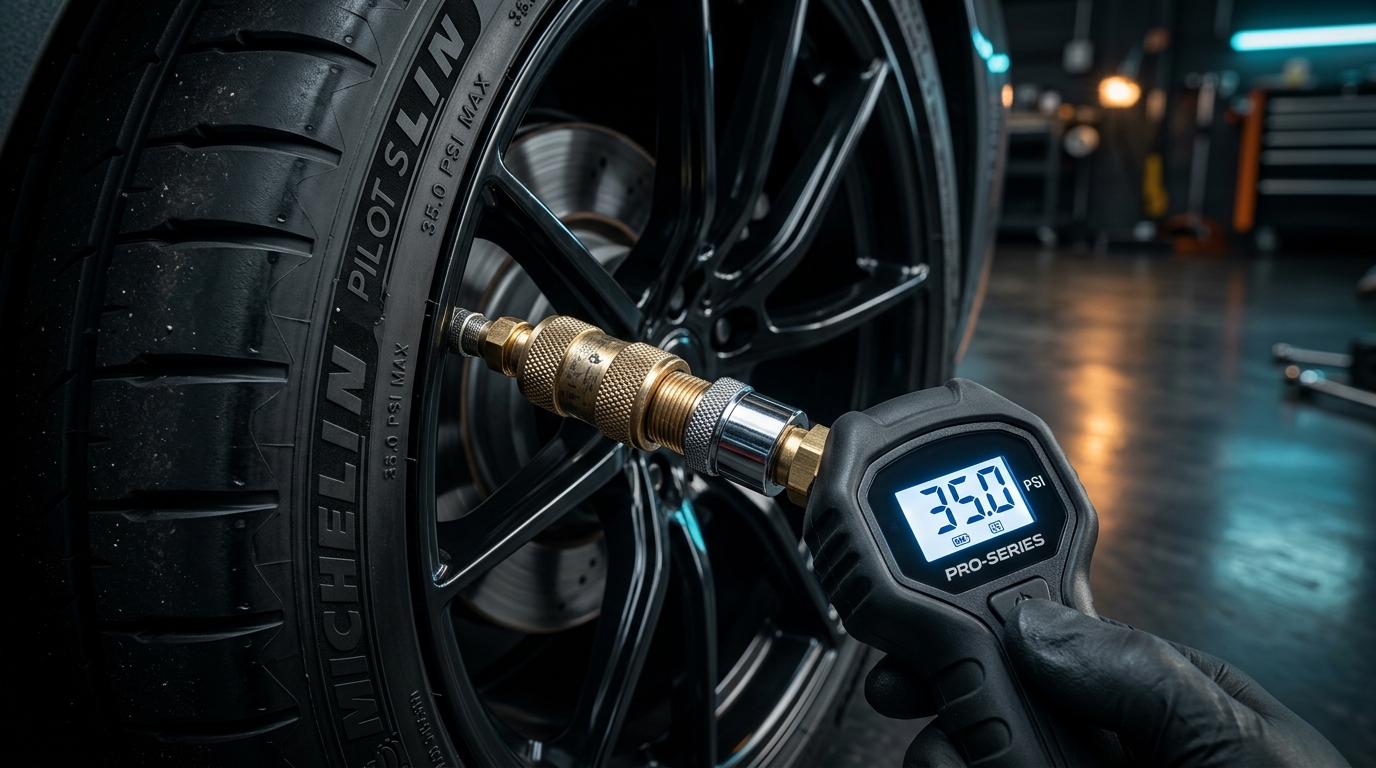
Digital pressure gauges and calibrated dial gauges with brass Bourdon tubes are far more accurate than traditional pencil-style stick gauges. Pencil gauges often stick due to road grime and can easily be off by 3 to 5 PSI.
Does tire pressure affect my speedometer accuracy?
Yes. A severely under-inflated tire has a reduced loaded radius (the distance from the wheel hub center to the ground). This causes the tire to complete more revolutions per mile, making your speedometer read slightly faster than your true ground speed. You can test geometric variances using our Tire Size Comparison Calculator or compare wet stopping distances in our Hydroplaning Guide.