How to Read Tire Sidewall Numbers: 7 Best Secrets & Decoder Tool

Learning how to read tire sidewall numbers is essential for every vehicle owner. Molded into the outer rubber ring of every automotive tire sits a standardized alphanumeric code—such as P225/50R17 94V—that serves as the tire's structural blueprint. Understanding these markings prevents dangerous fitment errors, premature suspension wear, and costly wheel damage.
When you purchase replacement rubber, matching the original equipment manufacturer (OEM) load rating and speed capacity is critical. According to engineering publications from the Society of Automotive Engineers (SAE), operating tires below their recommended load index or speed classification increases internal heat buildup, elevating the risk of high-speed tread delamination.
Interactive Tire Sidewall Decoder & Spec Analyzer
Mastering how to read tire sidewall numbers is simple with our interactive decoder. Select a popular vehicle fitment preset or enter your tire's sidewall markings below to instantly calculate physical dimensions, rolling circumference, payload capacity, and rubber age.
How to Read Tire Sidewall Numbers: Complete Zone Breakdown
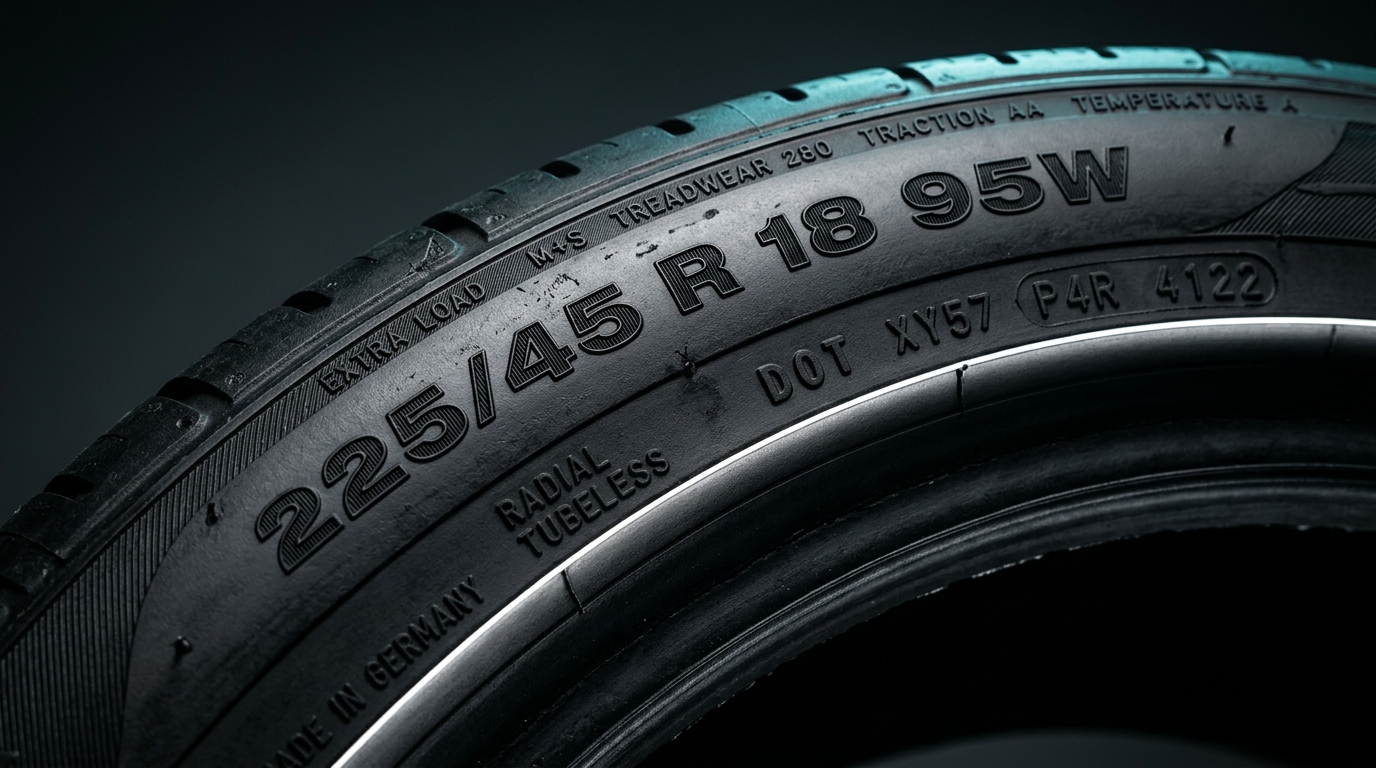
When investigating how to read tire sidewall numbers, breaking down the standard formula simplifies the entire process. Consider a typical touring tire labeled P225/50R17 94V. Each segment corresponds to a strict geometric or mechanical specification:
Tire Class Prefix (P, LT, ST, or None)
The first letter indicates the vehicle application standard. P stands for P-Metric passenger car tires designed for sedans, coupes, and light crossovers. LT indicates Light Truck tires, engineered with reinforced plies and higher inflation pressures for heavy payloads and towing. ST indicates Special Trailer service, which should never be used on drive or steering axles. Euro-metric tires lack a prefix entirely but follow standardized European ETRTO fitment standards.
Section Width (e.g., 225 mm)
The three-digit number following the prefix represents the nominal section width of the tire measured in millimeters from sidewall to sidewall at its widest point. A 225 tire is approximately 8.86 inches wide. If you are considering wider tires, verify wheel clearance and scrub radius using our Interactive Tire Size Calculator or compare sizing matrices in our Tire Conversion Chart before ordering.
Aspect Ratio / Profile Percentage (e.g., 50)
The two-digit number after the slash is the aspect ratio. It expresses the sidewall height as a percentage of the section width. In a 225/50 tire, the sidewall height is 50% of 225 mm, which equals 112.5 mm (4.43 inches). Lower profile tires (such as 35 or 40) deliver responsive steering feedback but transmit more road harshness, while higher profiles (65 or 70) provide an expansive air cushion for ride comfort.
Internal Construction (e.g., R)
The letter R designates Radial internal construction, where internal ply cords radiate 90 degrees outward from the wheel bead. Radial design stabilizes the tread footprint independently from sidewall flex, maximizing traction and tire life. Diagonal bias-ply tires (marked with a D or B) are now restricted to antique classic vehicles and agricultural machinery.
Wheel Rim Diameter (e.g., 17 Inches)
This number specifies the diameter of the wheel rim in inches that the tire beads are engineered to mount onto. A 17 tire must exclusively be mounted on a 17-inch wheel. To see how increasing rim diameter impacts ride quality and speedometer error, explore our Wheel Plus Sizing Fitment Guide.
Load Index (e.g., 94)
The two- or three-digit number represents the tire's maximum load-carrying capacity at its maximum cold inflation pressure. A load index of 94 corresponds to 1,477 lbs (670 kg) per tire. Never replace OEM tires with tires of a lower load index, as excessive payload causes dangerous internal belt heating and carcass failure. For complete weight tables, review our Tire Speed Rating & Load Index Guide.
Speed Rating (e.g., V)
The final letter represents the tire's maximum certified highway velocity under full load. A V rating certifies safe operation up to 149 mph (240 km/h). Installing tires with an insufficient speed rating compromises vehicle handling stability and braking response during emergency maneuvers.
How to Read Tire Sidewall Numbers: Load Index & Speed Classifications
A crucial part of how to read tire sidewall numbers is interpreting the combination of load index and speed rating, known in automotive engineering as the Service Description. Reference the standardized tables below when matching replacement tires to your vehicle's door jamb placard specifications:
Standard Passenger & Light Truck Load Index Matrix
| Load Index | Max Weight / Wheel | Metric Carrying Capacity | Typical Vehicle Platforms |
|---|---|---|---|
| 82 | 1,047 lbs | 475 kg | Subcompact hatchbacks |
| 87 | 1,201 lbs | 545 kg | Compact sedans & coupes |
| 91 | 1,356 lbs | 615 kg | Midsize cruisers (Accord, Camry) |
| 94 | 1,477 lbs | 670 kg | Touring sedans & small SUVs |
| 98 | 1,653 lbs | 750 kg | Midsize crossovers & minivans |
| 103 | 1,929 lbs | 875 kg | 3-Row SUVs & Electric Vehicles |
| 108 | 2,205 lbs | 1,000 kg | Half-ton pickups (F-150, Silverado) |
| 115 | 2,679 lbs | 1,215 kg | Heavy-duty 3/4-ton work trucks |
Standardized Automotive Speed Rating Classifications
| Rating Symbol | Max Sustained Velocity | Primary Application |
|---|---|---|
| S | 112 mph (180 km/h) | Commercial vans, family haulers |
| T | 118 mph (190 km/h) | Standard passenger cars, winter tires |
| H | 130 mph (210 km/h) | Sport touring sedans, crossovers |
| V | 149 mph (240 km/h) | Performance luxury sedans |
| W | 168 mph (270 km/h) | High-performance sports cars |
| Y | 186 mph (300 km/h) | Exotic sports coupes, track-ready sedans |
| (Y) | 186+ mph (300+ km/h) | Hypercars & specialized track exotics |
How to Read Tire Sidewall Numbers: Decoding the DOT Date Code
Knowing how to read tire sidewall numbers also includes verifying tire age. Tire rubber naturally degrades over time regardless of whether a vehicle is driven daily or stored in a garage. Exposure to atmospheric ozone, UV sunlight, and oxygen causes the chemical plasticizers in vulcanized rubber to oxidize, turning supple tread blocks brittle and vulnerable to tread separation.
To determine the exact manufacturing date, inspect the inner or outer sidewall near the wheel bead for the letters DOT. Follow the serial string to the final four digits stamped inside an oval enclosure:
- First Two Digits (24): Identifies the calendar week of manufacture (Week 24 corresponds to mid-June).
- Last Two Digits (23): Identifies the year of manufacture (2023).
According to guidelines published by the NHTSA and major tire manufacturers, tires should undergo professional visual inspection annually after 5 years of service, and should be retired from highway use when reaching 6 to 10 years of age, regardless of remaining tread depth. Test your tread depth using our When to Replace Tires Guide and cross-reference millimeters with our Tread Depth Millimeter Chart.
How to Read Tire Sidewall Numbers: UTQG Ratings & Special Markings
Beyond standard sizing dimensions, mastering how to read tire sidewall numbers involves identifying regulatory markings that define durability, seasonal performance, and vehicle manufacturer approvals:
UTQG Quality Grades
Mandated by the US Department of Transportation, the Uniform Tire Quality Grading (UTQG) system rates three metrics:
- Treadwear: A comparative rating (e.g. 500 wears 2.5 times longer than baseline 200).
- Traction: Wet straight-line braking ability graded AA, A, B, or C.
- Temperature: Resistance to highway heat dissipation graded A, B, or C.
3PMSF vs. M+S Markings
A tire marked only M+S (Mud and Snow) denotes geometry with open tread voids, but no certified cold-weather grip testing. A genuine severe-weather winter tire features the Three-Peak Mountain Snowflake (3PMSF) emblem, certifying compliance with standardized snow acceleration traction tests. Learn more in our All-Season vs All-Weather vs Winter Tires Comparison or check regional winter rules in our Winter Tyres UK Guide.
Run-Flat Identifiers
Run-flat tires incorporate reinforced sidewall inserts allowing driving up to 50 miles at 50 mph with zero inflation pressure. Manufacturers label run-flats differently: SSR (Continental), RFT (Bridgestone), ZP (Michelin), or ROF (Goodyear). Check out our Run-Flat vs Conventional Tires In-Depth Analysis.
OEM Manufacturer Approvals
Automakers collaborate with tire producers to tune rubber compounds for specific handling characteristics. Marked on the sidewall, common symbols include: * (BMW), MO (Mercedes-Benz), AO (Audi), and N0/N1/N2 (Porsche).
How to Read Tire Sidewall Numbers: 4 Critical Mistakes to Avoid
Drivers learning how to read tire sidewall numbers frequently encounter these four replacement pitfalls:
- Dropping Load Index for Cheaper Alternatives: Installing tires with a lower load index than specified on your vehicle's driver door placard causes excessive sidewall deflection, overheating, and dangerous tire failure under passenger or luggage loads.
- Inflating to the "MAX PSI" Stamped on Sidewall: The pressure molded on the sidewall (e.g. 51 PSI MAX) is the maximum safety limit for the rubber casing, not your vehicle's operating pressure. Always inflate to the cold PSI specified on your vehicle door sticker. Review our Cold vs Hot Tire Pressure Dynamics Guide.
- Mismatched Aspect Ratios Across All-Wheel-Drive Axles: On AWD vehicles, variations in rolling diameter exceeding 1% cause constant rotational speed discrepancies between axles, overheating the central differential transfer case.
- Ignoring Irregular Wear Patterns: Abnormal wear such as cupping, feathering, or inner shoulder wear indicates underlying suspension misalignment. Diagnose alignment issues with our 7 Critical Tire Wear Patterns Diagnostic Guide and maintain safe rotation patterns via our Tire Rotation Patterns & Torque Specs Guide.
Frequently Asked Questions: How to Read Tire Sidewall Numbers
Can I replace my 225/50R17 tires with 225/55R17?
When evaluating how to read tire sidewall numbers for plus-sizing, remember that a 225/55R17 tire has a 5% taller sidewall, increasing overall rolling diameter by roughly 0.9 inches (3.6%). This variance will cause your speedometer to read approximately 2.2 mph slower at 60 mph and could cause clearance rubbing against suspension struts on compact chassis.
What does "XL" stamped after the tire size indicate?
XL stands for Extra Load. When learning how to read tire sidewall numbers on modern heavy vehicles, notice that XL tires feature reinforced internal plies that allow operation at higher pneumatic pressures (up to 42–50 PSI) to carry greater load capacity than standard-load (SL) tires of identical exterior dimensions. XL tires are standard equipment on modern heavy battery electric vehicles (EVs).
Where can I find genuine discounts on brand-name tires?
Before paying full retail prices at local tire centers, check our curated Discount Tires Buying Guide & Rebate Checklist to maximize savings on top-tier tire brands, or explore wet safety limits in our Hydroplaning & Braking Guide.