7 Critical Tire Wear Patterns: Diagnostic Guide & Best Alignment Fixes
Understanding abnormal tire wear patterns is the single most effective way to identify severe suspension failure, improper wheel alignment, and pneumatic pressure imbalances before catastrophic blowout risks occur.

The Mechanical Physics of Abnormal Tire Wear Patterns
Your vehicle’s tires are the sole mechanical link connecting a multi-ton chassis to the road surface. Under ideal kinematic conditions, the pneumatic contact patch distributes vehicle curb weight, cornering lateral g-forces, and braking torque evenly across the entire tread face. However, when suspension linkages deflect, steering tie rods loosen, or inflation pressures drift, distinct tire wear patterns emerge as physical blueprints of mechanical distress.
Automotive chassis engineers evaluate tread rubber degradation not simply as cosmetic wear, but as an early diagnostic indicator. According to research published by the Society of Automotive Engineers (SAE), uneven tire wear can reduce wet-weather braking efficiency by up to 34% long before reaching the legal 2/32-inch wear bar indicator.
Interactive 3D-Style Tire Wear & Alignment Diagnostic Lab
Select a visible tire wear pattern or click a quick preset to inspect real-time kinematic cross-section distortion, contact patch load distribution, and laser alignment correction.
7 Critical Tire Wear Patterns Explained by Automotive Specialists
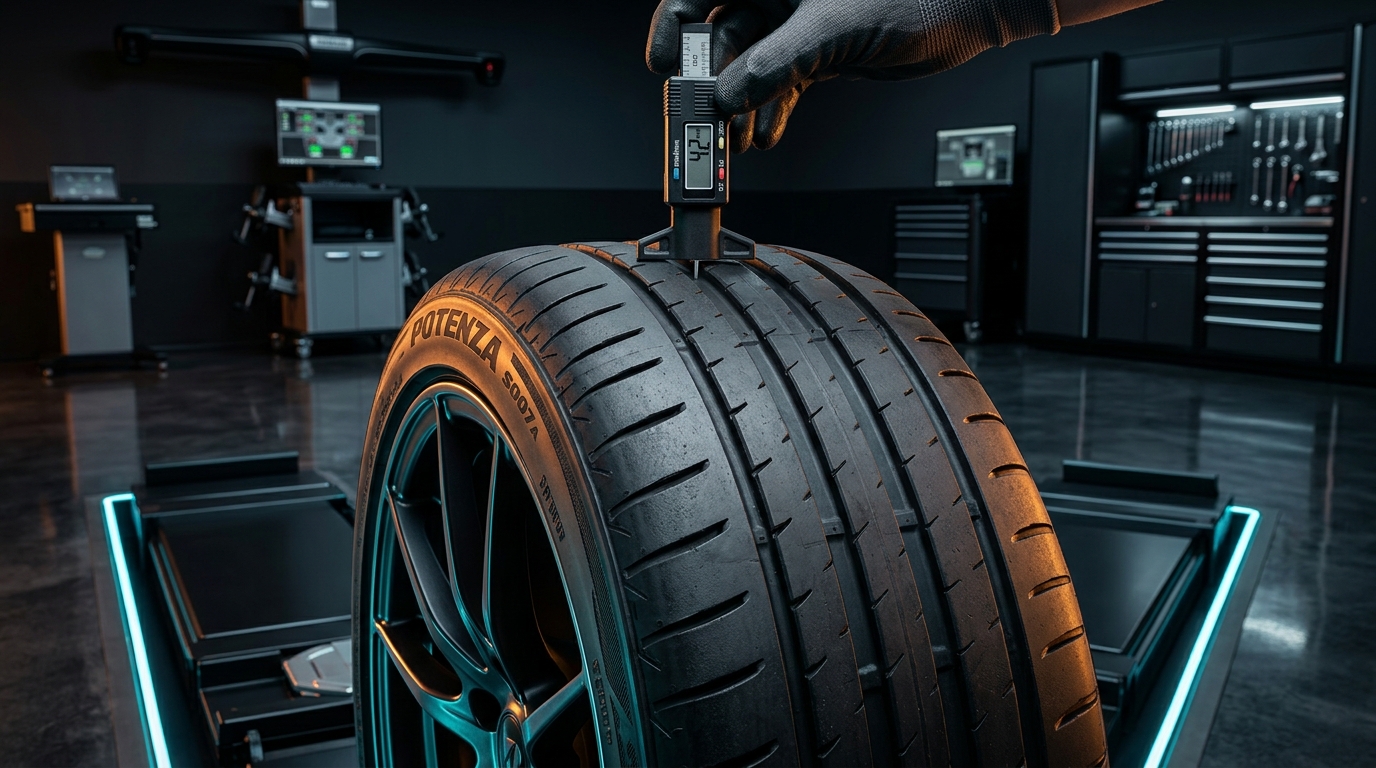
Systematic visual inspection paired with digital tread depth measurements reveals clear distinctions between pneumatic inflation anomalies and structural alignment errors. Here is how each of the 7 primary tire wear patterns manifests:
Inner Shoulder Camber Wear
Visual Symptom: The innermost 25% of the tire tread is worn down significantly faster than the center or outer shoulder, frequently exposing steel belts while the rest of the tire shows healthy tread.
Mechanical Cause: Excessive negative camber (wheel tilting inward at the top) or severely sagging suspension springs, worn lower control arm bushings, or bent struts. It is exacerbated if your car has undergone lowering springs without camber correction bolts.
Outer Shoulder Camber Wear
Visual Symptom: The exterior shoulder of the tire exhibits rapid scrub wear while the inner edge retains substantial groove depth.
Mechanical Cause: Excessive positive camber (wheel tilting outward at the top) or aggressive high-speed cornering where dynamic body roll overloads the outer contact patch. Damaged upper ball joints and twisted spindle arms also cause this pattern.
Both Shoulders Worn (Under-Inflation)
Visual Symptom: Both the inner and outer shoulders are uniformly bald or worn thin, while the central circumferential channels remain deep.
Mechanical Cause: Chronic under-inflation. When pneumatic tire pressure drops below factory placard specifications, the central tread buckles upward, concentrating vehicle curb weight onto the rigid sidewall supports.
Center Rib Crown Wear (Over-Inflation)
Visual Symptom: The central tread grooves wear down to minimum limits while both shoulder ribs preserve generous tread depth.
Mechanical Cause: Severe continuous over-inflation. Excessive bar/PSI pressure causes the tire carcass to balloon outward, reducing the effective contact footprint to a narrow strip along the centerline.
Cupping and Scalloped Treads
Visual Symptom: Repeating dips, scoops, or undulating waves around the circumference of the tread blocks, creating an audible roaring or rhythmic droning noise at highway cruising speeds.
Mechanical Cause: Compromised shock absorbers, worn suspension struts, or severely out-of-balance wheel assemblies. When a damping damper fails, the wheel bounces continuously against the highway pavement, gouging out rubber sections upon each rebound strike.
Feathered Tread Edges (Toe Scrubbing)
Visual Symptom: Tread blocks feel smooth when running your palm across the face in one direction, but feel sharp and jagged like shark skin when running your hand in the opposite direction.
Mechanical Cause: Misaligned steering toe angles (toe-in or toe-out). Toe error forces the tire to be dragged sideways as the vehicle drives straight ahead, shaving off the trailing edges of each individual tread block.
Diagonal Patching & Heel-Toe Wear
Visual Symptom: Alternating high and low points diagonally skewed across the tire surface, or individual tread blocks that tilt from front to rear.
Mechanical Cause: High mileage on solid rear axles, bent trailing arms, or lack of routine tire rotations on front-wheel drive platforms with heavy forward weight distributions.
Tread Depth Differential Measurement Matrix (32nds of an Inch)
Professional automotive technicians use digital tread depth calipers across three distinct zones: Outer Shoulder, Center Rib, and Inner Shoulder. A variance exceeding 2/32″ across any two zones confirms an active mechanical misalignment.
| Observed Wear Pattern | Outer Depth | Center Depth | Inner Depth | Primary Mechanical Cause | Safety Severity |
|---|---|---|---|---|---|
| Normal Uniform Wear | 7/32″ | 7/32″ | 7/32″ | Proper Alignment & Cold PSI | Optimal Safety |
| Negative Camber Wear | 8/32″ | 6/32″ | 2/32″ | Negative Camber / Sagging Springs | Critical Belt Risk |
| Positive Camber Wear | 2/32″ | 5/32″ | 8/32″ | Positive Camber / Bent Spindle | High Wear Rate |
| Chronic Under-Inflation | 3/32″ | 7/32″ | 3/32″ | Operating Below Recommended PSI | High Heat Blowout |
| Chronic Over-Inflation | 7/32″ | 3/32″ | 7/32″ | Operating Above Recommended PSI | Reduced Traction |
| Toe-Out Scrubbing | Feathered Smooth | Normal | Feathered Sharp | Tie-Rod Kinematic Misalignment | Rapid Tread Scrub |
| Shock Absorber Cupping | Undulating Dips | Scalloped | Wavy Low Spots | Blown Shocks / Unbalanced Rim | Braking Loss |
Wheel Alignment Angles vs. Pneumatic Pressures: Root Differences
Differentiating between alignment geometry failures and pneumatic tire pressure imbalances prevents costly misdiagnoses. The National Highway Traffic Safety Administration (NHTSA) stresses that while pressure is driver-adjustable, wheel angles require precision optical laser alignment rigs.
Alignment Kinematic Angles
- Camber: Vertical tilt of wheel in degrees. Negative camber wears inner edges; positive wears outer edges.
- Toe: Direction wheels point relative to vehicle centerline. Toe-in/out scrubs tread sideways, causing feathering.
- Caster: Forward/rearward tilt of steering axis. Affects straight-line stability and steering return.
Pneumatic Pressure Dynamics
- Under-Inflation: Overloads structural bead shoulders, creating twin-shoulder wear and internal heat delamination.
- Over-Inflation: Stiffens carcass, elevating centerline contact pressure and vulnerability to impact punctures.
- Thermal Fluctuations: Ambient temperature changes cause 1 PSI variance for every 10°F change.
5-Step Corrective Protocol to Eliminate Abnormal Tire Wear Patterns
Once anomalous tire wear patterns are discovered, follow this structured automotive repair protocol to preserve tire longevity and vehicle directional control:
- Execute a 3-Point Depth Measurement: Record tread depths at the inside, center, and outside grooves using an accurate digital gauge. If any zone measures below 2/32″, immediate tire replacement is legally mandated.
- Perform Suspension Joint Inspection: Inspect ball joints, tie rod ends, control arm bushings, and strut mounts on an automotive two-post lift using a pry bar to check for mechanical play.
- Laser 4-Wheel Kinematic Alignment: Have an alignment shop adjust camber, caster, and toe to factory OEM tolerances (±0.10 degrees). Request a printed pre- and post-alignment specification sheet.
- Dynamic Road-Force Wheel Balancing: Balance all four wheel assemblies on a modern road-force balancer to neutralize high-speed harmonic vibrations that trigger cupping.
- Implement a Strict 5,000-Mile Rotation Schedule: Rotate non-directional tires front-to-back in an X-cross pattern to even out drivetrain torque scrubbing.