Tire Rotation Patterns & Torque Simulator
Select your vehicle drivetrain, tire tread type, and wheel stud configuration to visualize the exact tire swapping sequence and factory lug nut torque star patterns.
 By Bilal Khan • Lead Automotive Fitment Specialist • TiresTreads.com
•
Mechanical Safety Audit: October 2026
•
Technical Benchmarks: SAE J2530 Standard & Tire Industry Association (TIA)
Engineering Guide: Tire Rotation Patterns & Lug Nut Torque Specifications
Regular tire rotation is one of the most critical maintenance procedures for extending tire tread longevity, preserving directional handling stability, and maintaining manufacturer mileage warranty eligibility. While your vehicle’s engine transmits power through either the front, rear, or all four wheels, steering and braking forces subject individual tire shoulders to vastly asymmetrical stresses.
By implementing standardized tire rotation patterns every 5,000 to 7,500 miles—and ensuring alloy wheel lug nuts are tightened to factory torque specifications using a calibrated torque wrench—motorists prevent irregular heel-and-toe wear, eliminate high-speed steering wheel vibrations, and protect delicate wheel studs from shearing.
1. Why Drive Wheels Wear Faster: The Mechanical Physics
On front-wheel-drive (FWD) passenger cars, the front tires perform three exhausting mechanical duties concurrently: transmitting drive torque to the road, executing 100% of steering directional changes, and absorbing approximately 65% to 75% of total braking force. Consequently, front tires on FWD vehicles typically wear out at twice or three times the rate of rear tires if proper tire rotation patterns are neglected.
Conversely, rear-wheel-drive (RWD) sports cars and pickup trucks transfer heavy acceleration torque through the rear contact patches while the front tires manage cornering turn-in. Without systematic tire rotation patterns, tires develop localized tread scrub, resulting in premature failure before reaching their theoretical 50,000-mile life cycle. Understanding these tire rotation patterns ensures your rubber compound wears flat and true. If you notice localized shoulder wear or cupping, cross-reference our diagnostic Tire Wear Patterns Guide.
2. Standard Tire Rotation Patterns Explained
The Tire and Rim Association (TRA) and major tire manufacturers categorize rotation methodologies based on vehicle drivetrain layout and tire construction. Following OEM-approved tire rotation patterns preserves optimal vehicle handling balance:
| Drivetrain / Setup | Recommended Rotation Pattern | Primary Benefit | Applicable Vehicles |
|---|---|---|---|
| Front-Wheel Drive (FWD) | Forward Cross (X-Cross) | Balances intense front shoulder scrubbing | Honda Civic, Toyota Corolla, Hyundai Elantra |
| Rear-Wheel Drive (RWD) | Rearward Cross | Distributes straight-line acceleration wear | Ford Mustang, BMW 3-Series, Ram 1500 |
| All-Wheel Drive (AWD / 4WD) | X-Pattern / All-Wheel Cross | Protects sensitive transfer case center differentials | Audi Quattro, Subaru Outback, Toyota RAV4 AWD |
| Directional Tread Tires | Front-to-Back (Same Side) | Preserves hydroplaning rain evacuation channels | High-performance sports tires (Michelin Pilot Sport) |
| Staggered Fitment (Different Sizes) | Side-to-Side (Only if non-directional) | Equalizes left/right turning scuff | BMW M-Series, Corvette, Porsche 911 |
Different chassis architectures demand specific tire rotation patterns. On symmetrical all-wheel-drive vehicles, maintaining identical rolling circumference across all four tires is mandatory to prevent viscous coupler overheating. Choosing the correct tire rotation patterns prevents costly drivetrain repairs.
3. Wheel Lug Nut Torque Specs & The Star Sequence Rule
Tightening wheel lug nuts is not simply a matter of making them “as tight as possible.” Over-torquing lug nuts with pneumatic impact guns stretches wheel studs past their tensile elastic yield point, warps thin brake rotors causing pedal pulsation, and cracks aluminum alloy lug seats. Under-torquing allows wheel lug nuts to back off during highway operation, leading to catastrophic wheel detachment.
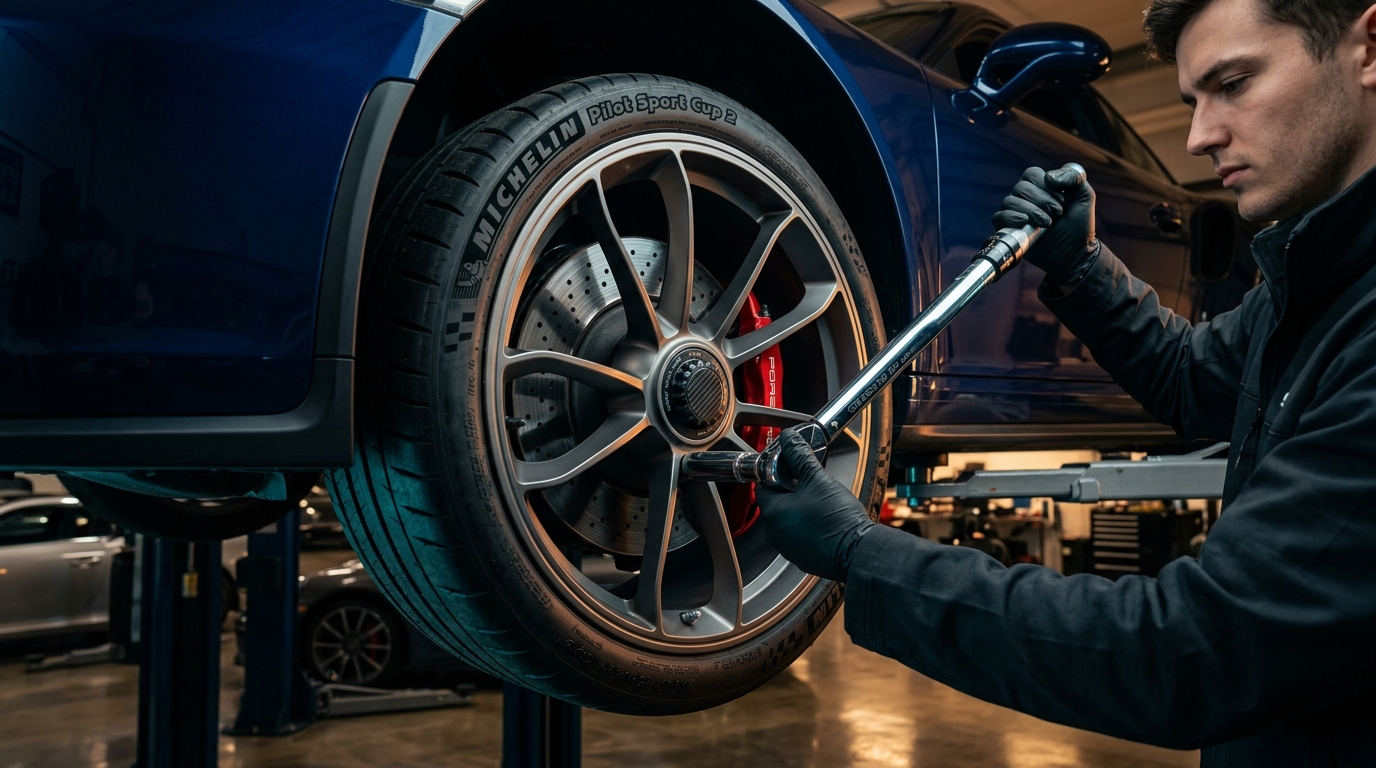
Whenever completing your scheduled tire rotation patterns, always ensure the clamping force is evenly applied using a calibrated torque wrench in a criss-cross star sequence.
4. Quick Reference Lug Nut Torque Matrix
| Stud Size / Thread Pitch | Vehicle Segment | Torque (Foot-Pounds / lb-ft) | Torque (Newton-Meters / N•m) |
|---|---|---|---|
| M12 x 1.25 | Nissan, Subaru, Infiniti | 75 – 85 lb-ft | 100 – 115 N•m |
| M12 x 1.50 | Toyota, Honda, Mazda, Hyundai, Ford | 80 – 90 lb-ft | 108 – 122 N•m |
| M14 x 1.50 | Chevy Silverado, Ford F-150, Tesla, Ram | 120 – 150 lb-ft | 162 – 203 N•m |
| 1/2″-20 | Jeep Wrangler, Classic Ford / Mopar | 95 – 110 lb-ft | 128 – 149 N•m |
| 9/16″-18 | Heavy-Duty Ram 2500 / F-250 Trucks | 135 – 165 lb-ft | 183 – 224 N•m |
5. Thermal Expansion & Lug Nut Clamping Physics
A frequent engineering pitfall encountered after executing tire rotation patterns is failing to account for coefficient of thermal expansion differences between steel wheel studs and cast or forged aluminum alloy wheels. Aluminum expands at approximately double the rate of structural carbon steel under thermal cycling:
- Thermal Expansion of Aluminum: Approximately 22 – 24 × 10-6 m/(m•K).
- Thermal Expansion of Grade 10.9 Steel Studs: Approximately 11 – 12 × 10-6 m/(m•K).
During aggressive downhill braking or sustained highway cruising, friction between brake pads and cast-iron rotors generates temperatures exceeding 500°F (260°C). As heat conducts into the wheel hub, the aluminum wheel center expands faster than the steel studs, creating tremendous additional tensile clamping stress. If lug nuts were initially over-tightened during a routine tire rotation, this thermal surge can stretch wheel studs beyond their yield limit, leading to sudden highway fatigue shearing.
6. Dry Torque vs. Wet Torque: The Anti-Seize Hazard
Automotive OEM service manuals establish wheel lug nut torque specifications based exclusively on clean, dry threads. Applying motor oil, WD-40, or copper/aluminum anti-seize lubricant to wheel studs is a dangerous mistake commonly seen in amateur tire rotations:
7. Step-by-Step Professional Tire Rotation Protocol
To achieve consistent tire longevity and road safety when executing your seasonal tire rotation patterns, follow this professional 5-step shop workflow:
- Initial Cold Inspection: Measure tread depth across inner, center, and outer circumferential grooves using a calibrated brass gauge. If asymmetric wear exceeds 2/32″, check suspension alignment.
- Vehicle Lift & Hand Threading: Raise vehicle safely on rated jack stands. Remove wheels and position them according to your designated drivetrain layout (Forward Cross, Rearward Cross, or X-Pattern). Hand-thread all lug nuts a minimum of 4 to 5 full turns before touching tools.
- Initial Star Snug Stage: Using a hand ratchet or torque stick set to 30 lb-ft, snug lug nuts down in an alternating star pattern to center the wheel conical/ball seats onto the hub ring.
- Final Ground Torquing: Lower the vehicle until tires make firm contact with the asphalt. Set your calibrated micrometer torque wrench to factory specification and tighten each lug nut until the distinct mechanical click is felt. Follow the sequence: 1 → 3 → 5 → 2 → 4.
- The 100-Mile Retorque Rule: Wheel alloys undergo micro-settling under road vibration. Re-apply the torque wrench after 50 to 100 miles of driving to verify clamping load integrity.
Frequently Asked Technical Questions
How often should I rotate my tires?
Most automotive manufacturers and tire brands recommend rotating tires every 5,000 to 7,500 miles, or at every oil change interval. If you drive an aggressive performance car or frequently tow heavy trailers, consider rotating every 4,000 miles to maximize tread life. Check current tread depths with our Penny Test Tread Depth Guide.
What happens if you rotate directional tires incorrectly?
Directional tires are engineered with V-shaped tread grooves designed to roll in one specific direction to pump standing water away from the contact patch. If mounted backwards, wet traction is severely compromised, hydroplaning risk increases dramatically, and road noise becomes noticeably louder. Directional tires can only be rotated front-to-back on the same side unless dismounted from the rim.
Should lug nuts be re-torqued after tire rotation?
Yes. Automotive safety guidelines recommend re-checking lug nut torque after driving approximately 50 to 100 miles following any wheel installation. Thermal expansion cycles and settling of aluminum wheel faces can cause minor clamp load changes.
Can I rotate a full-size matching spare into the rotation?
Yes, if your vehicle carries a full-size matching spare tire and wheel (common on Jeep Wranglers and 4×4 trucks), a 5-tire rotation pattern should be followed. This ensures all five tires wear down at an equal rate, giving you 20% longer overall lifespan before purchasing a replacement set. Review discount shopping strategies in our Discount Tires Buying Guide.