Seasonal Testing & Chemistry Guide
 By Bilal Khan • Lead Automotive Fitment Researcher • TiresTreads.com • Published: October 17, 2026 • 10 Min Read
Interactive Seasonal Tire Advisor & Compound Simulator
Live Thermomechanical PhysicsRecommended Category
All-Weather Tire (3PMSF)
Michelin CrossClimate 2 / Bridgestone WeatherPeak
Rubber Polymer State
Elastic Silica Hybrid Active
Micro-sipes conform to freezing pavement down to 14°F.
Snow Stopping (from 30 mph)
~72 Feet
33 feet shorter than standard factory all-season tires.
Seasonal Swap Requirement
Zero Swaps (365 Days)
Safe to drive in 95°F summer heat without rapid tread decay.
📖 Table of Contents: All-Season vs All-Weather vs Winter Tires Guide
All-Season vs All-Weather vs Winter Tires: The 45°F (7°C) Thermal Rule
The single biggest misconception about winter driving is that snow traction is all about tread depth. While deep grooves matter, tread depth is completely useless if the underlying rubber is rock-hard.Pneumatic tire rubber contains natural polymers, synthetic elastomers, plasticizers, and silica. In tire engineering, 45°F (7°C) represents the widely accepted industry threshold established by the ETRTO European Tyre and Rim Technical Organisation where standard all-season rubber compounds begin to lose their elastic flexibility. While the actual chemical glass transition temperature (Tg) of tire polymers occurs much lower, 45°F marks the practical operational boundary where summer-biased compounds stiffen noticeably.The Golden Temperature Threshold: 7°C (45°F)
When ambient air drops below 45°F, standard all-season rubber compound stiffens and acts like a hockey puck on cold pavement, even before a single snowflake falls.
At 7°C (45°F) and below:- All-Season Tires: Their rubber hardens. The microscopic contact patch cannot conform to microscopic road imperfections, dramatically lengthening stopping distances on clean, dry, but freezing asphalt.
- Winter & All-Weather Tires: Their compounds are infused with high concentrations of silica and specialized vegetable oils (like canola or sunflower oils). This keeps the tread blocks supple and pliable even at −30°C (−22°F), allowing the rubber to wrap around pavement texture and bite into ice. For severe winter mandates, also see our UK & European guide on winter tyres UK regulations.
All-Season vs All-Weather vs Winter Tires: Stopping Distance Test Data on Snow & Ice
When analyzing all-season vs all-weather vs winter tires, independent laboratory tests and the NHTSA winter vehicle safety research consistently show winter tires stopping significantly shorter on snow and ice than standard all-season tires:| Tire Category | Stopping from 30 mph on Snow | Stopping from 12 mph on Ice | Cold Wet Braking (40°F) |
|---|---|---|---|
| Dedicated Winter (e.g. Blizzak WS90) | 60 feet | 28 feet | Solid & Confident |
| All-Weather (e.g. CrossClimate 2) | 72 feet (+12 ft) | 36 feet (+8 ft) | Excellent Evacuation |
| Standard All-Season (OEM Factory) | 105 feet (+45 ft!) | 55 feet (+27 ft!) | Noticeable Skid Slide |
*Illustrative reference data based on published winter track evaluations adhering to ASTM F1805 standards, comparing dedicated studless ice/snow tires against standard all-season compounds. Real-world stopping distances vary depending on vehicle curb weight, ABS tuning, and ice temperature.
Look at that snow stopping distance in this all-season vs all-weather vs winter tires benchmark: 60 feet versus 105 feet. That extra 45 feet is roughly three full car lengths. In a real-world panic stop at an icy red light or a highway backup, those three car lengths are the difference between stopping with a racing heartbeat or crunching straight through someone’s trunk lid. To analyze high-speed standing water dispersion, review our detailed guide on hydroplaning dynamics and wet braking distances. For size dimensions, cross-reference our tire conversion chart.All-Season vs All-Weather vs Winter Tires: Head-to-Head Comparison
1. All-Season Tires: The Fair-Weather Default
Most vehicles roll off the dealership showroom floor on all-season rubber. In any comparison of all-season vs all-weather vs winter tires, standard all-seasons are engineered to deliver 50,000 to 80,000 miles of tread life, run whisper-quiet on smooth turnpikes, and provide predictable handling in summer rain.- Best For: Drivers living in warm, temperate climates (like Southern California, Texas, Florida, or low-elevation coastal zones) where snow is non-existent and temperatures rarely hover below freezing.
- The Limitation: Completely out of their element in freezing slush, packed snow, or freezing rain. If you live anywhere that sees sub-freezing mornings for three months straight, all-seasons are a compromise you should reconsider.
2. All-Weather Tires: The Year-Round Breakthrough
All-Weather tires are the newest revolution in automotive rubber. Unlike standard all-seasons, true all-weather tires bridge the performance gap in the all-season vs all-weather vs winter tires dilemma, earning the official Three-Peak Mountain Snowflake (3PMSF) emblem stamped on the sidewall.- How They Work: They utilize advanced hybrid silica compounds that resist heat breakdown during 95°F summer heatwaves while remaining soft enough to grip sub-zero winter roads. They feature directional V-shaped tread blocks and high-density 3D sipes that claw through snow.
- Best For: Drivers in areas with moderate winter seasons (like the US Mid-Atlantic, Midwest metro areas, or European temperate zones) who want genuine severe-snow traction without the headache and expense of storing and swapping a second set of wheels twice a year.
- Top Models: Michelin CrossClimate 2, Bridgestone WeatherPeak, Goodyear Assurance WeatherReady 2, and Nokian WR G4.
3. Dedicated Winter Tires: The Sub-Zero Specialists
In the true test of all-season vs all-weather vs winter tires, dedicated snow tires remain the undisputed masters of severe cold, heavy snowfall, and glare ice. They feature thousands of microscopic zigzag slits called sipes cut into every tread block. As the tire rolls, these sipes flex open, scoop up snow, and trap it inside the grooves. Snow sticks to snow with remarkable friction (shear adhesion), providing claw-like traction.- Best For: Mountain passes, rural northern roads, Canada, New England, the Upper Midwest, or any region with heavy accumulated snow and persistent black ice.
- The Summer Penalty: You must swap winter tires off in the spring. Driving winter tires on 75°F (24°C) asphalt will cause the hyper-soft compound to squirm, dramatically lengthen dry braking distances, and chew through the entire tread in 4,000 to 6,000 miles. Also monitor pressures in freezing weather using our tire pressure cold vs hot guide and verify load thresholds with our tire speed rating and load index chart.
All-Season vs All-Weather vs Winter Tires: Sidewall Symbols (3PMSF vs M+S)
When shopping for seasonal rubber, never rely on a salesman telling you a tire is “good in snow.” Look at the rubber sidewall yourself:M+S (Mud and Snow): This is a geometric standard, not a performance test. It only means the tire has a tread pattern with at least 25% open void area. It involves zero cold-weather stopping tests. Almost every cheap tire in the world carries an M+S stamp.3PMSF (Three-Peak Mountain Snowflake): An international laboratory test standard governed by the ASTM F1805 single wheel driving traction test. Tires must deliver at least 110% of the snow traction of a standard reference test tire on packed snow to earn this mountain crest. Look for this symbol if you ever encounter winter roads.
For a detailed breakdown of all other letters and numbers on your sidewall, read our companion guide on How to Read Tire Sidewall Numbers & Markings.All-Season vs All-Weather vs Winter Tires: The All-Wheel Drive (AWD) Myth
In real-world driving, we constantly hear: “I drive a Subaru / Audi Quattro / 4×4 pickup, so I do not need winter tires. My all-wheel drive handles the snow.”Critical Driving Physics: All-wheel drive helps you accelerate from a dead stop without spinning your wheels. It does nothing to help you steer through an icy corner, and it does absolutely nothing to help you stop. When you hit the brakes, every vehicle on the road is a four-wheel braking vehicle. If all four tires are hard, glassy rubber, AWD cannot save you from sliding through an intersection.
An inexpensive front-wheel-drive hatchback on dedicated winter tires will out-brake, out-turn, and out-maneuver a $70,000 4×4 SUV riding on worn all-season tires on packed snow every single day of the week. To preserve uniform grip across all axles, maintain recommended rotations via our tire rotation patterns and torque specs guide.All-Season vs All-Weather vs Winter Tires: Cost & Longevity Analysis
Many drivers avoid winter tires because buying a second set feels like spending double. But let us do the practical mileage math:- When you run two sets of tires (summer/all-season for 7 months, winter for 5 months), your tires only wear down while they are on the car.
- Instead of wearing out one set of all-seasons in 3 years, your two sets will last you 6 years combined.
- The only real ongoing cost is the semi-annual wheel swap (or mounting them onto dedicated inexpensive steel wheels once). You are not buying extra miles—you are simply pre-paying for rubber you would have had to purchase down the road anyway.
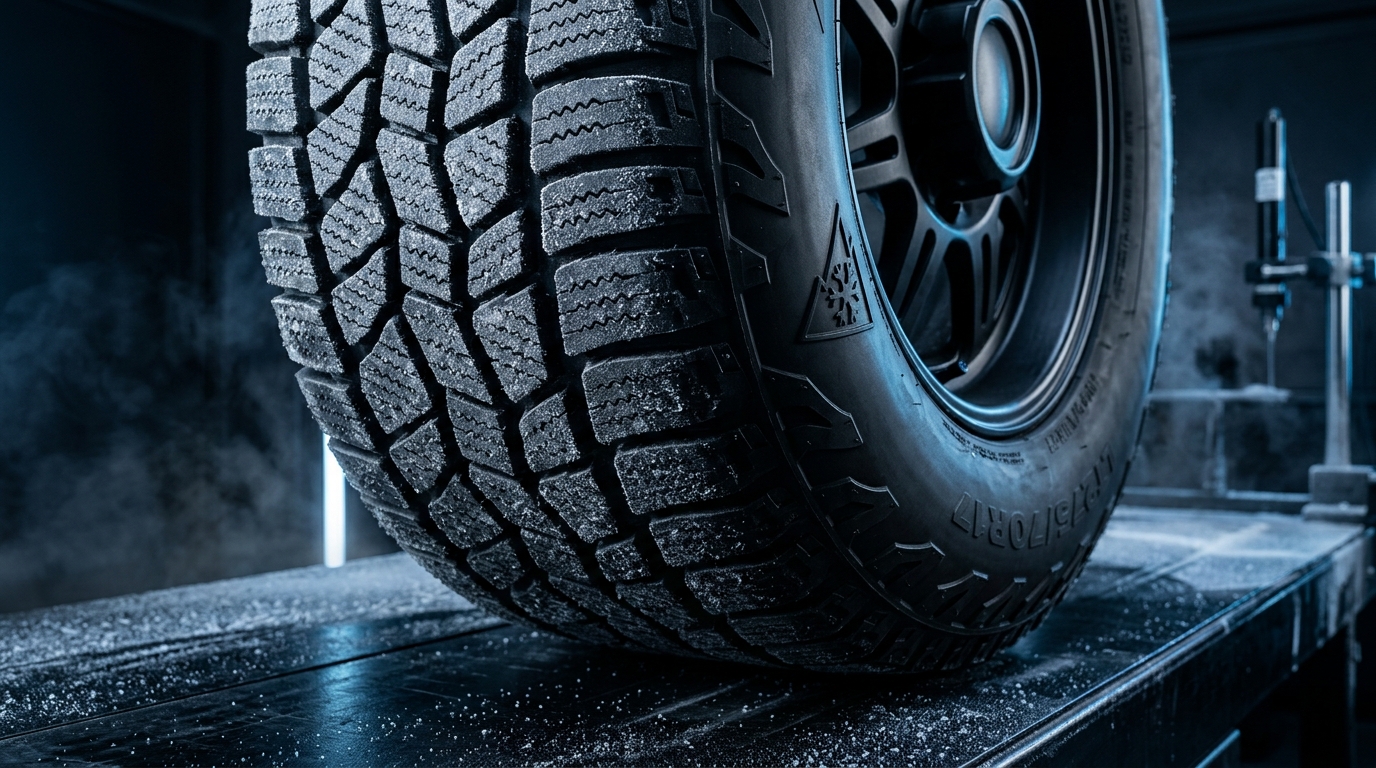
Figure 1: Laboratory comparison of all-season vs all-weather vs winter tires, showcasing dense 3D zigzag micro-sipes, flexible cold-weather silica compound, and the 3PMSF severe snow mountain emblem.
All-Season vs All-Weather vs Winter Tires: Frequently Asked Questions
Can I just put winter tires on the drive wheels (front or rear only)?
No. Never mount winter tires on only two wheels. If you put them on the front of a front-wheel-drive car, the front will grip while the rear swings out in an uncontrollable oversteer spin on the first icy curve. If you put them on the rear of a rear-wheel-drive car, the car will push straight through turns without steering authority (understeer). Always install matching seasonal tires on all four corners.How much tread depth do winter tires need to work in snow?
While the legal baldness threshold for dry roads is 2/32 of an inch, winter tires stop working effectively in snow once they wear past 5/32” to 6/32” (4.8 mm). At that point, the micro-sipes are mostly worn away. To measure your remaining groove depth accurately, check our When to Replace Tires Guide and cross-reference our Tread Depth Millimeter Chart. Also inspect your grooves for irregular alignment wear using our tire wear patterns guide.Are All-Weather tires as good as dedicated Winter tires on ice?
All-weather tires match dedicated snow tires in light to moderate snow and slush. However, on sheer, mirror-like black ice or extreme sub-zero hardpack, dedicated winter tires like the Bridgestone Blizzak or Michelin X-Ice still hold a 15% to 20% braking advantage due to specialized hydrophilic multi-cell compounds.Can I drive All-Weather tires in 100°F summer heat?
Yes. That is the exact engineering breakthrough of all-weather rubber. They are formulated to handle scorching highway asphalt without the rapid degradation and tread squirm of pure winter rubber.Do winter tires hurt my fuel economy?
Slightly. Winter tires have higher rolling resistance due to flexible tread blocks and deeper sipes. Expect a small 1 to 2 MPG drop, which is a minor price to pay for the safety and collision prevention they deliver.
Final Verdict: Choosing Between All-Season vs All-Weather vs Winter Tires
When evaluating all-season vs all-weather vs winter tires for your vehicle, prioritize your lowest sustained winter road temperature. If your climate stays above 45°F year-round, standard all-seasons are economical. If you face freezing mornings and moderate snowstorms, modern all-weather tires eliminate seasonal tire swaps. For severe sub-zero climates and frequent packed ice, dedicated winter tires remain the safest, most capable engineering choice.
About the Author: Bilal Khan
Automotive enthusiast, wheel fitment researcher, and lead technical writer at TiresTreads.com. Bilal has spent several years diagnosing wheel offsets, tire rubber compounds, and chassis geometry to give drivers honest, practical advice they can trust.