Tire Treads: Types, Tread Depth, Wear Patterns, and When to Replace Your Tires

You might have a tire that still looks acceptable from the side, but feels noticeably less confident the moment it starts raining. The steering can feel loose on damp asphalt, or you might detect an annoying repeating road hum that wasn't there six months ago. In most vehicles, that subtle warning sign originates right where rubber meets the road: the tire tread.
Tire treads play an essential role in grip, wet-weather water evacuation, emergency braking distance, and handling stability. The pattern and depth dictate how your car behaves on dry asphalt, standing puddles, gravel shoulders, and winter slush. Just as importantly, their wear pattern serves as an open diagnostic window into your wheel alignment, suspension health, and inflation habits.
You do not need to be a professional mechanic to understand your tires. With a quick monthly visual check, an inexpensive tread depth gauge, and an eye for uneven wear patterns, you can make informed decisions before costly mechanical damage or dangerous hydroplaning occurs.
Interactive 3D-Style Tread Depth & Safety Caliper
Drag the caliper slider or choose a preset to inspect live rubber block height, relative water evacuation capacity, and estimated wet highway stopping distance models.
Full factory groove height with maximum rain channel evacuation capacity.
Standard stopping distance on fresh rubber with zero wet-braking penalty.
Channels easily blast away heavy surface water at highway speeds.
Deep sipes and grooves deliver confident grip in rain and winter slush.
- What Are Tire Treads? (Anatomy & Structure)
- Why Tire Treads Matter (5 Core Mechanical Roles)
- Common Types of Tire Tread Patterns (Symmetrical to Winter)
- Understanding Tire Tread Depth & Safety Benchmarks
- How to Accurately Check Tread Depth at Home
- Common Tire Tread Wear Patterns and What They Mean
- How to Make Your Tire Treads Last Longer
- When Should You Replace Your Tires? (5 Trigger Points)
- Common Tire Tread Mistakes to Avoid
- Frequently Asked Questions About Tire Treads
What Are Tire Treads?
The tire tread is the patterned rubber surface that makes direct physical contact with the road. It consists of a precise matrix of raised rubber sections, continuous grooves, and microscopic laser sipes engineered to perform distinct fluid and traction functions.
When you look at a new tire, you see wide longitudinal channels, angled lateral cuts, and geometric blocks. These features are not styling decorations; they are active hydraulic pumps designed to maintain mechanical friction under severe dynamic loads.
Contact Footprint: Raised sections of rubber that carry the vehicle's weight and generate mechanical friction for acceleration, cornering, and braking.
Hydraulic Channels: Deep longitudinal channels running along the circumference that rapidly pump standing water away from the contact patch.
Microscopic Grippers: Thin razor slits cut through tread blocks that flex open under load to slice through liquid films on wet roads, snow, and ice.
Cornering Stabilizers: Outer block edges that sustain heavy lateral weight transfer through turns and give early clues about camber misalignment.
Diagnostic Rib: The center portion of the tire where localized wear immediately indicates excessive inflation pressure.
Why Tire Treads Matter: 5 Core Mechanical Functions
Many drivers assume that grooved rubber is purely about dry grip. In reality, a slick motorsport tire provides superior friction on clean, dry pavement. Street tires require grooves because public roads present unpredictable weather, puddles, loose grit, and cold temperatures.
1. Grip on Wet Roads & Hydroplaning Prevention
Rain creates a thin liquid film. Deep grooves provide evacuation channels so water escapes. Without adequate depth, dynamic water pressure lifts the rubber, causing complete loss of steering (hydroplaning).
2. Emergency Braking Performance
Tires need surface grip to decelerate two tons of metal. Worn tread can add up to 100+ feet of stopping distance on wet highways—often the difference between a near-miss and a severe rear-end collision.
3. Handling & Steering Stability
Tread blocks support lateral forces when you turn the steering wheel. Evenly worn tread preserves predictable vehicle balance, while unevenly worn tires cause pulling, wander, and unstable tracking.
4. Acoustic Comfort & Road Noise
Tread block sequencing breaks up air resonance inside the grooves. If your tires develop an aggressive repeating hum or drone, uneven heel-toe wear or cupping is usually the underlying cause.
5. Surface Versatility
A paved touring tire relies on fine siping and quiet ribs, whereas all-terrain tires feature wide, open void ratios to bite into gravel, loose dirt, and slush without packing the channels full.
Common Types of Tire Tread Patterns
Tire manufacturers engineer six distinct tread geometries to meet different climate and performance requirements. Understanding each pattern ensures you choose the right rubber when comparing options on our tire conversion chart:
| Tread Pattern | Best Application | Rotation Flexibility | Key Characteristic |
|---|---|---|---|
| Symmetrical | Everyday commuter sedans, crossovers | Any corner (front, rear, cross) | Uniform ribs, quiet highway ride, longest lifespan |
| Asymmetrical | Touring, luxury, and sport sedans | Side-to-side (maintain outside stamp) | Dual face: inner rain grooves, outer stiff cornering shoulders |
| Directional | Heavy rain zones, performance sports cars | Front-to-back only (same side) | V-shaped chevron channels shooting water outward |
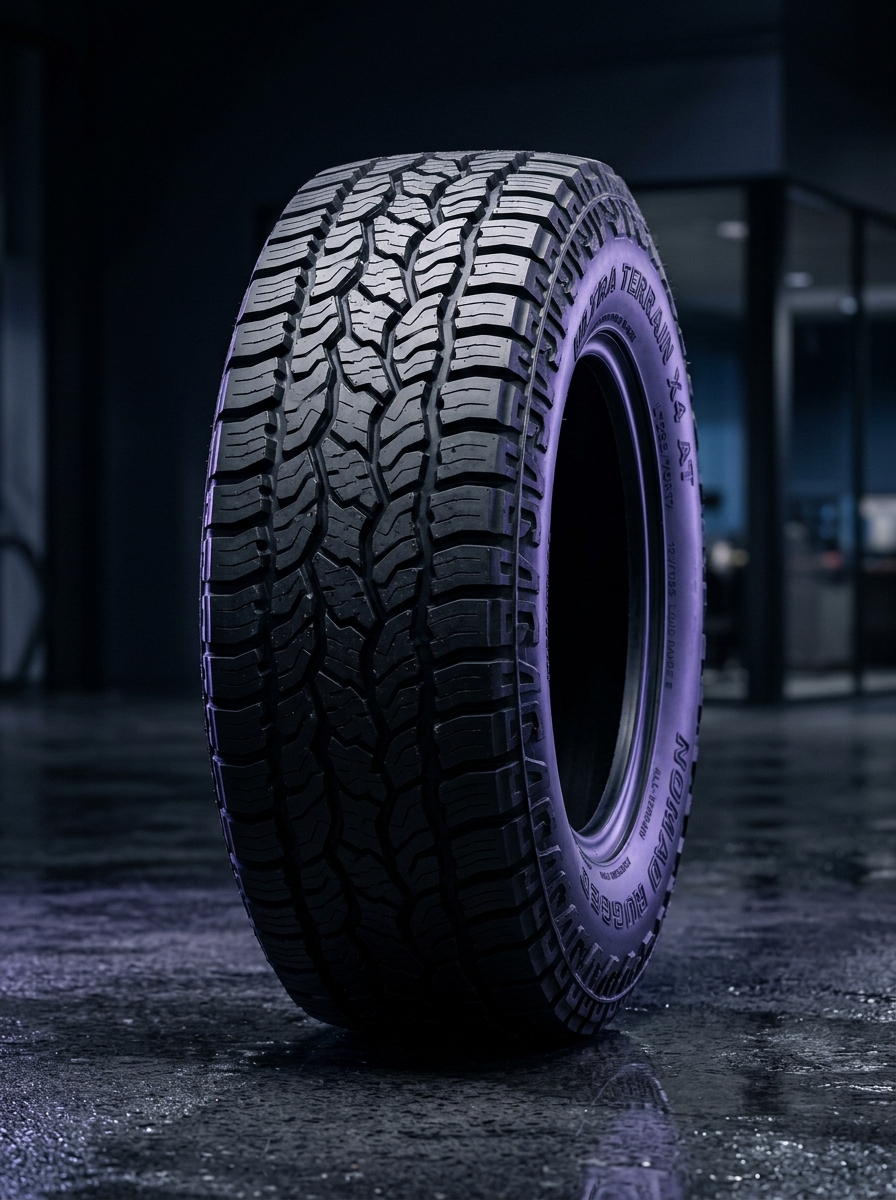
| All-Terrain (A/T) | Light trucks, SUVs, mixed highway/gravel | Standard 4WD X-rotation | Staggered block voids, stone ejectors, reinforced sidewalls |
| Mud-Terrain (M/T) | Dedicated off-road, deep mud, rocky trails | Axle swap or X-rotation | Massive self-cleaning voids; louder on paved highways |
| Winter / Snow | Freezing winter, hard-packed snow & ice | Follows directional or symm pattern | High-silica soft compound, 3PMSF rating, thousands of sipes |
Which Tread Pattern Should You Choose?
Always match the tire to the terrain you encounter 80% of the time. For daily commuting on paved highways, a quality touring or all-season symmetrical/asymmetrical tire delivers the best fuel economy, lowest noise, and longest mileage. If you frequently tow on unpaved gravel work sites, step up to a hybrid all-terrain tire. Never choose a tire purely based on its aggressive appearance; verify load capacity, speed index, and approved rim widths first.
What Is Tire Tread Depth?
Tread depth is the vertical measurement from the top of the rubber block face down to the bottom of the tire's deepest circumferential grooves. In the United States, it is expressed in 32nds of an inch, while internationally it is measured in millimeters (mm).
A new passenger tire leaves the factory with approximately 7 to 9 mm (10/32" to 11/32") of tread, while deep truck tires start at 12/32" to 14/32". As you drive, friction gradually shears away microscopic layers of rubber, reducing the depth available to displace standing highway water.
How to Check Tire Tread Depth at Home
You do not need to visit a dealership every time you want to verify your tires. An inexpensive mechanical or digital tread depth gauge costs under $10 and gives precise measurements in seconds:
Step 1: Park on a Flat, Safe Surface
Park on level pavement, switch off the engine, and firmly set your emergency brake. Turn your front steering wheel fully outward to give yourself complete visual and physical access to the front contact patch.
Step 2: Inspect the Entire Contact Patch
Check for embedded nails, sidewall bulges, rubber cracking, or exposed steel cords before measuring. Look closely across the inner shoulder, center rib, and outer shoulder.
Step 3: Position the Depth Gauge Probe
Press the gauge's flat base firmly against the outer rubber block. Push the measuring probe downward into the main circumferential groove until it touches the bottom floor. Avoid resting the probe directly on a raised wear bar.
Step 4: Take Multiple Readings Across Ribs
Never take just one reading. Measure across three distinct zones: inner shoulder, center groove, and outer shoulder. Significant differences between inside and outside indicate an alignment problem.
Step 5: Record & Track Readings Monthly
Note your measurements on your phone or vehicle log. Tracking wear over 5,000-mile intervals lets you anticipate replacement timing and proves your rotation schedule is working.
Common Tire Tread Wear Patterns and What They Mean
Your tire tread acts like a mechanical seismograph. It faithfully records mechanical stress, alignment misalignments, under-inflation, and worn suspension dampers. Reference our diagnostic console below to identify common wear signatures early:
➔ Under-Inflation: Insufficient air pressure forces the tire to sag in the middle, loading the outer shoulders. Increases rolling resistance and blowout risk.
➔ Over-Inflation: Excessive air pressure crowns the middle of the tire, focusing vehicle weight onto a narrow center strip. Produces harsh ride quality.
➔ Camber Misalignment: The wheel is leaning inward or outward from vertical, grinding one edge away. Requires four-wheel alignment.
➔ Toe Angle Fault: Tires are pointed slightly inward or outward relative to the vehicle's centerline, scuffing sideways down the highway.
➔ Worn Suspension Dampers or Imbalance: Shock absorbers are failing to keep the tire planted, allowing dynamic bouncing that scoops out rubber craters.
How to Make Your Tire Treads Last Longer
Premium tires represent a significant financial investment. Following five disciplined maintenance habits can extend usable tread life by 15,000 to 20,000 miles:
- Check Cold Tire Pressures Monthly: Tires lose approximately 1 to 2 PSI per month due to natural air permeation. Always check pressure in the morning before driving, using the door-jamb placard figures rather than sidewall maximums.
- Rotate Tires Every 5,000 to 7,000 Miles: Front steering axles carry 60% of vehicle mass and incur heavy cornering scrubbing. Regular rotation balances out wear across all four corners.
- Inspect Wheel Alignment Annually: Potholes, railroad tracks, and curb bumps slowly knock suspension toe and camber out of factory specifications.
- Adopt Smooth Driving Habits: Abrupt acceleration from stoplights, aggressive braking, and high-speed cornering generate excessive friction heat that melts away soft rubber compounds prematurely.
- Verify DOT Date Stamps: Check the four-digit DOT manufacturing date on the sidewall (e.g., "2425" = 24th week of 2025). Review our illustrated guide on how to read tire sidewall numbers to avoid buying aged warehouse inventory.
When Should You Replace Your Tires? (5 Trigger Points)
There is no single calendar date that dictates replacement. Instead, base your decision on physical condition, remaining groove volume, and observed handling:
- Wear Bars Are Flush (2/32" / 1.6 mm): When rubber reaches the molded TWI bridges, the tire is legally worn out and must be replaced immediately.
- Approaching 4/32" Before Winter or Rainy Season: If seasonal downpours or snowstorms are approaching, replacing tires at 4/32" preserves vital wet stopping defense.
- Visible Sidewall Damage or Bubbles: Impact blisters, deep gouges reaching cord layers, or cracking from ozone degradation require instant replacement regardless of tread depth.
- Six-Year Chronological Age Limit: Rubber compounds dry out and harden over time. Most automotive manufacturers recommend replacing tires after six years in service, even if tread depth looks acceptable.
- Persistent Vibration or Pressure Loss: Internal belt separation or slow bead leaks that resist standard puncture repair compromise highway safety.
Common Tire Tread Mistakes to Avoid
1. Judging Tires by Appearance Alone
A tire can look "fine" at a standing glance while its inner shoulder is ground down to exposed nylon cords. Always inspect across the full width.
2. Checking Only the Center Rib
Alignment problems typically destroy the inner or outer shoulders while leaving the center groove looking brand new. Check all three ribs.
3. Using the Sidewall Max Pressure
The PSI on the sidewall is the maximum structural limit, not your car's target. Always follow your vehicle's driver door-jamb placard.
4. Ignoring New Noise or Drones
Sudden humming or thumping sounds are not "road noise"—they indicate cupping, severe heel-toe wear, or broken internal steel belts.
5. Replacing Rubber Without Alignment
Installing brand new tires on an unaligned car will ruin your new $800 set within 5,000 miles. Always inspect suspension geometry first.
6. Assuming All Patterns Perform Alike
Aggressive mud-terrain blocks can hydroplane worse on wet highways than standard touring tires. Always match pattern to climate.
Frequently Asked Questions About Tire Treads
How deep should tire treads be?
Brand new passenger tires typically feature 7 to 9 mm (10/32" to 11/32") of tread. The legal minimum across North America and Europe is 1.6 mm (2/32"). However, wet stopping performance drops significantly below 4/32" (3.2 mm), and snow traction deteriorates below 6/32" (4.8 mm).
Are deeper tire treads always better?
Not necessarily. Excessive block height can cause "tread squirm," slightly reducing steering crispness on dry asphalt and generating extra heat. Optimal performance requires matching tread depth and pattern to your specific driving environment.
How often should I check tire tread depth?
A quick 2-minute monthly check is ideal. Always take readings before long cross-country highway road trips or when entering seasonal rainy and winter months.
Can I drive with uneven tire tread wear?
Mild uneven wear can be managed if caught early and corrected with an alignment. However, if one shoulder is worn smooth, cords are visible, or tread depth is under 2/32", the tire is unsafe and should be replaced immediately.
What is the difference between tire tread and tire tread depth?
Tire tread refers to the geometric pattern (blocks, sipes, grooves) molded across the tire surface. Tread depth is the physical vertical measurement from the outer block face down to the groove floor.
Do all-season tires have different tread from summer tires?
Yes. All-season tires feature deeper grooves and moderate siping to handle rain and light slush. Summer tires prioritize stiffer blocks, fewer sipes, and sticky compounds to maximize dry cornering and wet highway grip above 45°F (7°C).
Can I tell whether my tires need alignment by looking at the tread?
Yes. One-sided shoulder wear strongly points toward improper camber, while feathered or sawtooth block edges indicate toe misalignment. Have a certified technician check suspension components on an alignment rack.
Final Thoughts
Tire treads are easy to take for granted because they wear away slowly over years of daily driving. Yet those four small contact patches are all that stand between your vehicle and loss of control during emergency maneuvers.
Make it a habit to inspect tread depth monthly, check inflation pressures when tires are cold, and rotate your set on schedule. A few minutes of proactive inspection today protects your wallet and keeps you and your family safe on the road.
Editorial Note: This guide provides automotive engineering and safety reference information based on TRA and NHTSA standards. Always consult your vehicle's owner manual and a certified tire professional when inspecting structural damage or uneven wear.
About the Author: Bilal Khan
Bilal Khan is an automotive fitment researcher and lead technical contributor at TiresTreads.com. With extensive experience testing wet stopping distances, hydroplaning thresholds, and tire compound degradation, Bilal develops interactive safety calculators and guides to provide transparent, unbiased automotive education for drivers worldwide. Review his engineering portfolio on his Author Bio.