Tire Speed Rating & Load Index: Thermal Dissipation & Structural Integrity
Every pneumatic tire is a pressurized structural membrane operating under extreme mechanical and thermal stress. When examining a tire’s service description stamped on the sidewall—such as 91V, 95W, or 100Y Extra Load—it dictates two life-critical physical boundaries: the maximum certified vehicle speed sustainable before internal standing wave delamination, and the maximum static load capacity at specified inflation pressure. Ignoring these engineering thresholds risks belt separation, distorted anti-lock braking (ABS) calibration, and severe vehicle handling imbalances.
Table of Contents: Speed Rating & Load Index Matrix
Tire Speed Rating & Load Index Safety Evaluator
Select your tire speed rating symbol letter and numeric load index below to instantly compute continuous top speed, single-tire static carrying capacity, combined 2-tire axle GAWR limits, and thermal stress thresholds:
1. Anatomy of the Service Description: Where Speed Meets Load
When decoding a complete tire size specification such as 225/45R18 95Y XL, the dimensional figures (225 mm section width, 45% aspect ratio, 18-inch wheel rim diameter) describe physical fitment. However, the subsequent alphanumeric grouping—95Y—constitutes the Service Description:
- Load Index (e.g., 95): A standardized numerical code corresponding to the maximum static carrying mass per tire. A rating of 95 translates precisely to 1,521 lbs (690 kg) per tire at its baseline maximum operating cold pressure.
- Speed Symbol (e.g., Y): An alphabetical designation certifying the maximum velocity at which the tire can safely transport that rated load over sustained laboratory drum testing without thermal decomposition or belt lifting. “Y” certifies continuous capability up to 186 mph (300 km/h).
- Carcass Reinforcement Designation (e.g., XL / Extra Load): Indicates an internal carcass reinforced with higher ply tension and modified bead bundle geometry designed to sustain higher internal pressures (typically up to 42–50 PSI versus 36 PSI for Standard Load).
2. Complete Tire Speed Rating Chart (From Winter L to Exotic (Y))
In automotive safety engineering, speed ratings are determined via rigorous standardized dynamometer protocols established by the Economic Commission for Europe (ECE R30) and the US Federal Motor Vehicle Safety Standards (FMVSS 109/139). During certification, a tire inflated to specified pressure is forced against a large-diameter steel test drum under 80% to 100% of its rated static load. The drum velocity is accelerated in progressive 10 km/h (6.2 mph) increments every 10 minutes until sustained top speed is maintained for a full uninterrupted hour without structural failure.
| Speed Symbol | Max Sustained Speed (mph) | Max Sustained Speed (km/h) | Typical Vehicle Application |
|---|---|---|---|
| L | 75 mph | 120 km/h | Off-road equipment, agricultural machinery, heavy utility trailers |
| M | 81 mph | 130 km/h | Temporary compact spare tires (“doughnut” spares), heavy commercial |
| N | 87 mph | 140 km/h | Emergency spare tires, light commercial vans, studded winter tires |
| P | 93 mph | 150 km/h | Specialized severe-service winter tires, municipal maintenance vehicles |
| Q | 99 mph | 160 km/h | Rugged 4×4 Mud-Terrain (M/T) tires, Nordic studless ice tires |
| R | 106 mph | 170 km/h | Heavy-duty light truck (LT) tires, commercial delivery vans |
| S | 112 mph | 180 km/h | Family minivans, entry-level subcompact passenger cars, light SUVs |
| T | 118 mph | 190 km/h | Standard touring sedans, crossovers, standard all-season replacement tires |
| H | 130 mph | 210 km/h | Sport-tuned passenger sedans, modern compact SUVs, touring coupés |
| V | 149 mph | 240 km/h | High-performance sedans, luxury performance crossovers, hot hatches |
| W | 168 mph | 270 km/h | Ultra-High Performance (UHP) sports cars, executive autobahn tourers |
| Y | 186 mph | 300 km/h | Exotic supercars, high-horsepower track sedans (BMW M, AMG, Porsche) |
| (Y) | Above 186 mph | Above 300 km/h | Bespoke hypercars (Ferrari, Bugatti, Koenigsegg) with custom load certs |
3. Comprehensive Load Index Table: Calculating Axle Safety Margins
While speed ratings measure thermal dissipation limits, the Load Index measures structural compressive capacity. An automobile’s Gross Axle Weight Rating (GAWR)—the maximum certified weight on either the front or rear axle—must never exceed the combined load rating of the two mounted tires.
For instance, if your rear axle GAWR is 2,800 lbs, each individual rear tire must possess a minimum load capacity of 1,400 lbs. Referencing the load index matrix below, a load index of 93 (1,433 lbs / 650 kg) is required. Fitting a 90-rated tire (1,323 lbs) creates a compromised condition where severe suspension compression can rupture the internal casing.
| Load Index | Capacity (lbs) | Capacity (kg) | Load Index | Capacity (lbs) | Capacity (kg) |
|---|---|---|---|---|---|
| 80 | 992 lbs | 450 kg | 96 | 1,565 lbs | 710 kg |
| 82 | 1,047 lbs | 475 kg | 98 | 1,653 lbs | 750 kg |
| 84 | 1,102 lbs | 500 kg | 100 | 1,764 lbs | 800 kg |
| 86 | 1,168 lbs | 530 kg | 102 | 1,874 lbs | 850 kg |
| 88 | 1,235 lbs | 560 kg | 104 | 1,984 lbs | 900 kg |
| 90 | 1,323 lbs | 600 kg | 106 | 2,094 lbs | 950 kg |
| 92 | 1,389 lbs | 630 kg | 108 | 2,205 lbs | 1,000 kg |
| 94 | 1,477 lbs | 670 kg | 110 | 2,337 lbs | 1,060 kg |
4. Centrifugal Standing Waves & Thermal Degradation: Why Tires Fail at Speed
A standard touring tire cannot safely cruise at 140 mph, even on glass-smooth surfaces. The limiting factor is the physics of Centrifugal Standing Waves and elastomeric hysteresis:
As a tire rotates at 70 mph, every segment of the tread enters the contact patch, deflects flat against the pavement, and rebounds over 1,000 times per minute. At 130+ mph, the rotational frequency surpasses the physical recovery speed of standard synthetic styrene-butadiene rubber (SBR) compounds.
When rotational speed exceeds the natural damping frequency of the carcass plies, a sinusoidal standing wave forms immediately aft of the contact patch. This stationary buckle causes immense mechanical friction, generating internal temperatures in excess of 250°F (121°C).
Excessive thermal energy breaks down the sulfur cross-links established during vulcanization. The rubber softens internally, tensile adhesion between the steel belts and carcass degrades, and the tread package risks separating under load.
To prevent standing waves, high-speed tires rated W, Y, and (Y) incorporate specialized structural engineering:
- Spiral-Wound Aramid/Nylon Cap Plies: Jointless 0-degree reinforcement belts placed directly beneath the tread cap that physically resist centrifugal expansion.
- High-Silica Tread Polymers: Chemical compounding designed to maintain viscoelastic flexibility while minimizing internal heat buildup (low hysteresis loss).
- Stiffened Bead Bundles & High-Hardness Apex Fillers: Reduces lateral deflection around the wheel rim lip, stabilizing steering transients under high aerodynamic downforce.
5. Can You Mix Speed Ratings on the Same Vehicle? (The Axle Rule)
A frequent dilemma during replacement purchases—especially when shopping at discount tire retailers—is whether tires of different speed ratings can be safely installed together.
The 3 Non-Negotiable Industry Rules:
Mounting an H-rated tire on the left-front and a V-rated tire on the right-front is unsafe. Higher speed-rated tires feature stiffer sidewall carcasses and distinct slip angles. Under emergency braking or rain, this creates asymmetrical cornering traction, triggering Electronic Stability Control (ESC) intervention and potentially causing a spinout.
If you must mix pairs across axles (e.g., two H-rated tires and two V-rated tires), the higher-rated pair (V) must always be installed on the rear axle, regardless of whether your vehicle is Front-Wheel Drive (FWD), Rear-Wheel Drive (RWD), or All-Wheel Drive (AWD). Rear axle grip prevents dangerous oversteer (“fishtailing”) during wet emergency maneuvers.
Even if your rear axle has 186-mph Y-rated tires, having 118-mph T-rated tires on the front limits your vehicle’s safe operating envelope strictly to 118 mph. Operating beyond the lowest rating risks tire failure.
6. The Electric Vehicle (EV) Shift: SL vs XL vs HL Ratings
Modern battery electric vehicles (BEVs) like the Tesla Model 3/Y, Hyundai Ioniq 5, and Porsche Taycan have fundamentally shifted load and speed demands. Because battery packs add 800 to 1,500 lbs of curb weight while electric motors deliver instant maximum torque at 0 RPM, traditional Standard Load (SL) tires are often insufficient.
Designed for conventional internal combustion compacts and sedans. Internal carcass plies achieve maximum rated load at 35–36 PSI.
Features reinforced steel bead coils and denser polyester plies, allowing the tire to carry higher loads at elevated operating pressures (41–42 PSI).
The latest ISO standard engineered specifically for heavy electric SUVs and luxury EVs, carrying roughly 20–25% more weight than an SL tire of identical physical dimensions.
7. Workshop Testing Methodology: Verification Protocol by Bilal Khan

In our physical workshop audits across touring and high-performance vehicle fitments, speed rating compliance is verified through a rigorous 4-step chassis safety protocol:
- OEM Placard Plaque Cross-Examination: We audit the B-pillar tire and loading information placard. Replacement tires must meet or exceed the OEM speed letter (down-rating a factory V-spec vehicle to an S-spec tire is flagged as unsafe).
- Tire Pressure Cold-Hot Thermal Delta: Using calibrated digital gauges, we verify that tire pressures conform to cold inflation guidelines. Under-inflation by just 5 PSI reduces a high-speed tire’s effective rating by two entire letter categories due to increased sidewall flex.
- Tread Depth Wear Profile Check: Using analog brass depth gauges, we ensure that directional and asymmetrical tread patterns retain at least 4/32″ of depth before high-speed testing to prevent aquaplaning.
- Wheel Hub Lug Torque Inspection: Before road testing, every lug nut is verified to vehicle factory specs using calibrated click torque wrenches following our wheel torque specifications protocol.
8. Frequently Asked Questions: Speed Ratings & Load Index
Can I put winter tires with a lower speed rating on my car?
Yes. Recognized internationally by both the ECE and US DOT, you are legally permitted to install winter or snow tires with a lower speed rating symbol (for example, fitting Q-rated 99 mph or T-rated 118 mph winter tires on a car that originally came with V-rated 149 mph summer tires). However, in many jurisdictions (such as Germany and Canada), a visible reminder sticker indicating the lower maximum speed must be affixed to the dashboard in clear view of the driver.
What is the difference between V and Z speed ratings?
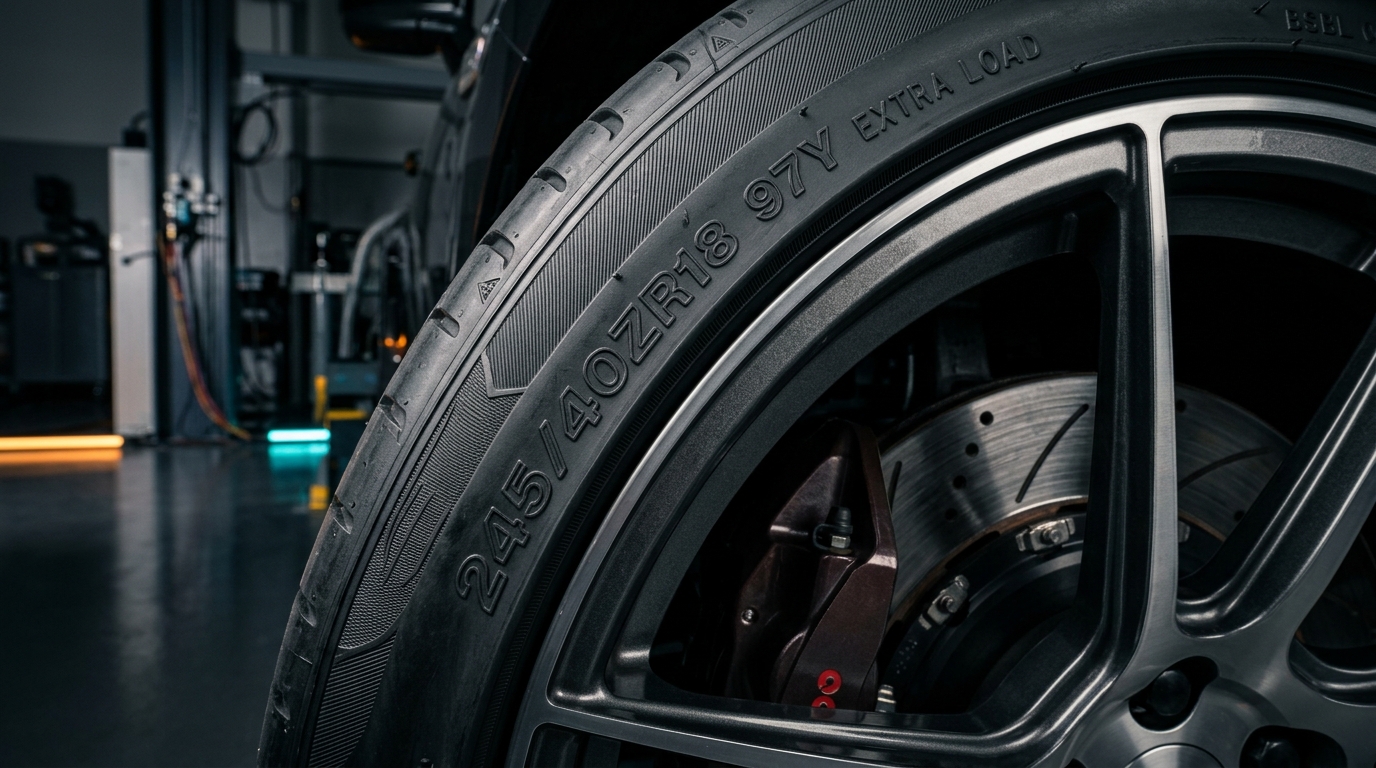
Prior to 1991, “Z” (or ZR) was an open-ended classification indicating capability exceeding 149 mph (240 km/h). As vehicle performance advanced, the industry introduced modern definitive letters: W (168 mph) and Y (186 mph). Today, you will often see “ZR” inside the size description (e.g., 245/40ZR18) accompanied by a specific modern service description like 97Y, which represents the exact legal certification standard.
Will a tire with a higher speed rating wear out faster?
Generally, yes. Tires engineered for high speed ratings (such as W and Y) utilize softer tread compounds with higher carbon black and silica ratios to generate mechanical grip and cornering stability under thermal load. While they offer superior braking and crisp steering response, their UTQG treadwear ratings are typically lower (200–340) compared to long-life T- or H-rated touring tires (500–700+).
Does a higher speed rating affect ride comfort and road noise?
Yes. High speed-rated tires feature stiffer sidewalls, extra spiral nylon/aramid cap plies, and rigid apex rubber to counteract centrifugal bulging. On rough asphalt, this extra stiffness translates to a firmer ride and slightly more road feedback compared to a flexible, compliant S- or T-rated touring tire.
Calculate Your Exact Tire Fitment & Sizing
Planning to upgrade your wheel rim diameter or change tire widths? Use our interactive 3D WebGL simulator to compute exact speedometer errors, sidewall height deltas, and clearance metrics.
Open Interactive Tire Size Calculator →