When to Replace Tires: Tread Depth Safety & The Penny Test
When to Replace Tires: Tread Depth Safety, TWI Wear Bars & The Coin Test
Understanding exactly when to replace tires is one of the most critical safety responsibilities of vehicle ownership. Most drivers wait until their car hydroplanes in a rainstorm or fails a mandatory state inspection. Here is the physical science behind tread wear bars, the difference between the Penny and Quarter test, and the critical 6-year rubber age rule.
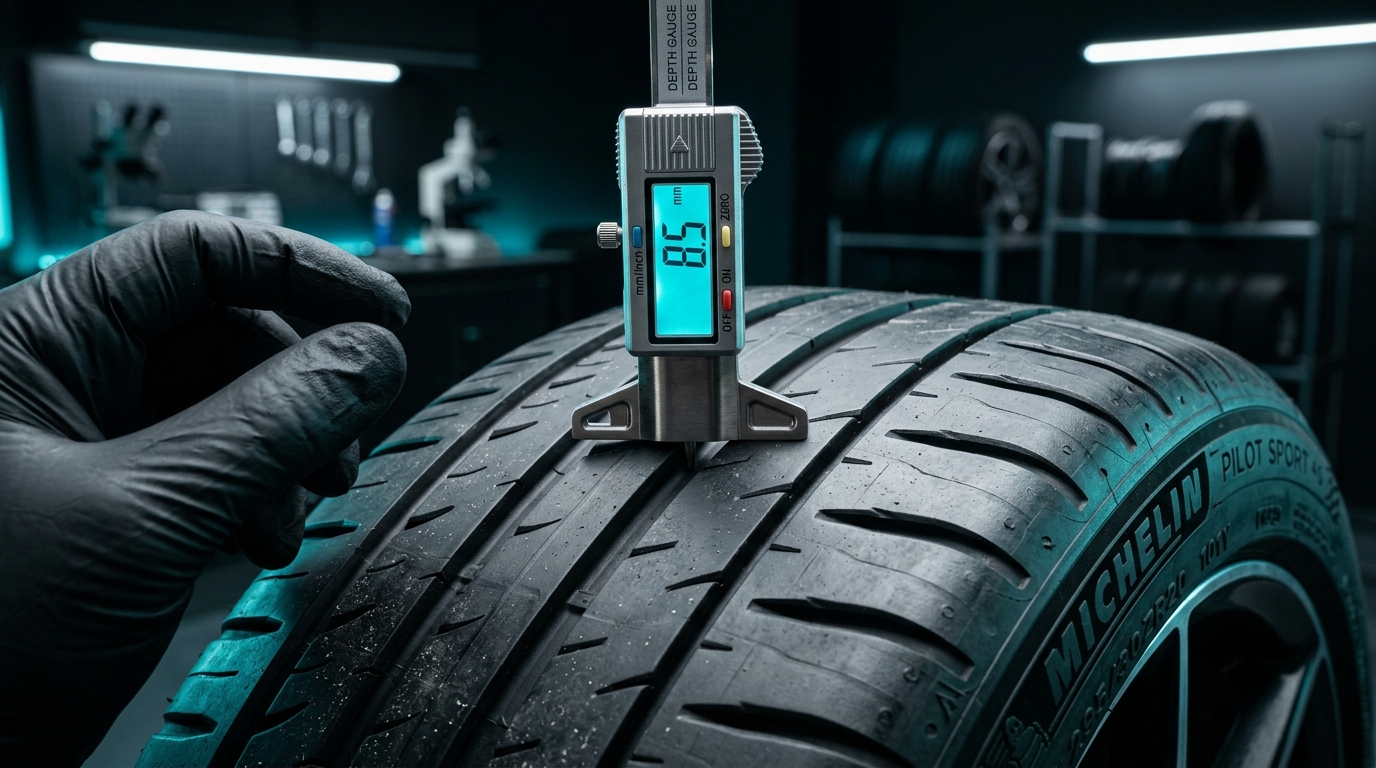
Interactive Penny & Quarter Tread Replacement Caliper
Wondering when to replace tires on your vehicle? Use our interactive 3D coin inspection simulator below: toggle between Lincoln's Penny, Washington's Quarter, and a digital depth gauge, drag the depth slider, and watch real-time coin head exposure, wet braking penalties, and legal inspection verdicts update live.
Technically street legal in dry weather, but fails wet safety guidelines. Evacuation volume drops by 50%.
Takes approximately 6 extra full car lengths to stop compared to fresh 10/32" tires.
Washington’s hair is exposed. Replace before autumn rainstorms or winter freezes.
Shop for replacement tires. Do not drive in torrential rain at high highway speeds.
- Interactive Penny & Quarter Tread Replacement Caliper
- The At-Home Coin Tests: Penny vs. Quarter Depth Limits
- Wet Stopping Distance: NHTSA & Tire Rack Empirical Data
- How to Read Built-in Tread Wear Indicators (TWI)
- The 6-Year Rule: Why Tires Expire Even With Full Tread
- Checking for Uneven Wear Across the Tread Face
- Frequently Asked Questions About Tire Replacement
During a wet autumn evening on an interstate bypass, I watched a clean crossover ahead of me enter a moderate highway curve at 60 mph. It wasn't pouring rain—just a typical highway sheen. Without warning, the vehicle's rear end drifted sideways across two lanes before violently regaining traction against the shoulder barrier.
When the tow truck arrived, I walked over to look at the tires. From a standing glance, they had plenty of black rubber. But a quick tactile check revealed that the inner tread channels were worn completely smooth.
That is why visual guesswork regarding when to replace tires is so hazardous. Tires rarely wear in a perfectly flat line across their face, and a tire with 2/32" remaining depth takes nearly double the physical distance to stop on wet pavement compared to fresh rubber.
At-Home Coin Tests: When to Replace Tires Using Penny vs. Quarter
If you don't own a dedicated millimeter depth gauge, pocket change provides a quick at-home method for determining when to replace tires. However, there is a crucial distinction between the traditional Penny Test and the recommended Quarter Test.
The Penny Test: Measuring the 2/32" Legal Minimum Threshold
Insert a standard US penny into several tread grooves with Abraham Lincoln's head upside down and facing you.
If the very top of Lincoln’s head is visible, your tread is at or below 2/32 inch (1.6 mm). In most US states and many other countries, 2/32 inch (1.6 mm) is the legal minimum wear limit. Your vehicle is illegal for road use and will fail safety inspections.
The Quarter Test: Evaluating 4/32" Wet Weather Braking Margins
Insert a US quarter into the grooves with George Washington's head upside down.
If Washington's hairline is fully exposed, your tread is at or below 4/32 inch (3.2 mm). While technically legal in dry weather, your wet weather stopping distance has degraded severely. Most automotive chassis engineers point to 4/32" as the critical safety threshold for when to replace tires before winter rain and slush arrive.
Wet Stopping Distance Data: Why Knowing When to Replace Tires Matters
Why does automotive safety research draw such a hard line regarding when to replace tires between 4/32" and 2/32"? The answer comes down to hydroplaning physics and water channel volume.
According to official vehicle safety benchmarks published by the National Highway Traffic Safety Administration (NHTSA) and empirical testing conducted by SAE International (Society of Automotive Engineers), driver reaction time combined with wet stopping distance expands dramatically as tread depths wear down:
| Tread Remaining | Water Channel Volume | Wet Stopping Distance (70→0 mph) | Additional Stopping Penalty |
|---|---|---|---|
| 10/32" – 11/32" (New) | 100% Full Capacity | ~195 Feet | Baseline (0 car lengths) |
| 4/32" (Quarter Line) | ~50% Capacity | ~290 Feet | +95 Feet (~6 car lengths) |
| 2/32" (Penny / TWI Line) | <15% Capacity | ~379 Feet | +184 Feet (~12 car lengths!) |
On bald 2/32" tires, your car requires roughly 12 additional car lengths to stop in wet highway conditions. At 60 mph, you are plowing through wet asphalt with zero margin for error.
Test Your Remaining Depth on Our 3D Caliper
Move the gauge slider from 12/32" down to 1/32" to watch live water evacuation channels shrink and stopping distances expand.
Built-in Tread Wear Indicators: Knowing When to Replace Tires
You don't actually need pocket coins to know when to replace tires—modern tires feature built-in visual wear gauges molded directly into their tread grooves from the factory.
Look along the upper shoulder of your tire sidewall for small molded symbols: a triangle (▲), the letters "TWI", or a manufacturer logo. Follow that mark directly inward across the face of the tread.
Inside the main circumferential grooves, you will see narrow, raised rubber ridges running perpendicular to the grooves. These are factory Tread Wear Indicator bars, calibrated to exactly 2/32 inch (1.6 mm) in height.
- Recessed Wear Bar: If the surrounding tread blocks sit well above the wear bar, you do not need to wonder when to replace tires just yet, as ample rubber remains.
- Flush Wear Bar: If the tread surface has worn down level with the wear bar, forming a continuous solid rubber strip across the tire face, the tire is 100% worn out and must be replaced immediately.
The 6-Year Age Limit Rule: When to Replace Tires Due to Dry Rot
One of the most dangerous misconceptions regarding when to replace tires is the belief that deep remaining tread automatically guarantees road safety.
Rubber is a complex organic polymer. From the day a tire leaves the manufacturing mold, it is exposed to environmental oxidation, ozone, and UV solar radiation. Over time, the specialized anti-aging wax compounds blended into the rubber evaporate, causing the rubber compound to become brittle and lose elasticity.
Chronological Rubber Degradation: The 6-Year DOT Aging Standard
Safety standards established by the Tire Industry Association (TIA) and major manufacturers recommend thorough professional inspections at 5 to 6 years of age, and many vehicle and tire manufacturers recommend replacement around 10 years regardless of remaining tread depth; check your vehicle owner's manual for specific guidance.
Check the 4-digit number at the end of the DOT serial stamp on your sidewall (e.g., "2419" means the 24th week of 2019). If your rubber is over 6 years old and shows micro-cracking in the groove channels, this is the definitive signal for when to replace tires regardless of tread depth. Learn how to decode these stamps in our Sidewall Numbers Guide.
Checking for Uneven Wear: When to Replace Tires vs. Align Wheels
When checking your vehicle to determine when to replace tires, never measure only one groove. Always take measurements across three distinct zones: the inner shoulder, the center rib, and the outer shoulder.
- Both Outer Shoulders Worn: The classic sign of chronic under-inflation. Review our Tire Pressure Dynamics Guide to fix pressure loss.
- Center Rib Worn Flat: Over-inflation. The tire is ballooning outward in the middle.
- One Single Shoulder Bald (Inner or Outer): Wheel alignment failure (excessive negative or positive camber, or toe out; diagnose alignment camber angles in our tire wear patterns diagnostic guide).
- Scalloped or Cupped Dips: Worn suspension dampers, loose ball joints, or severely unbalanced wheels.
Frequently Asked Questions: When to Replace Tires
Can I replace just one worn tire?
When deciding when to replace tires on two-wheel-drive vehicles, it is best practice to replace tires in axle pairs (both fronts or both rears) so rolling resistance and wet traction remain balanced. On All-Wheel-Drive (AWD) vehicles, all four tires must generally match within 2/32" to 3/32" of tread depth to prevent overheating differential clutches.
If I only buy two new tires, should they go on the front or rear?
When determining when to replace tires in pairs, always install new tires on the rear axle, regardless of whether your car is front-wheel drive, rear-wheel drive, or all-wheel drive. Deeper rear tread prevents oversteer fish-tailing in emergency wet braking, which is far harder for everyday drivers to control than understeer.
What does dry rot look like?
Dry rot appears as a network of fine spiderweb-like cracks or crazing along the sidewall rubber or down in the bottom of the tread channels. It indicates rubber oxidation and loss of structural elasticity.
How many miles should a set of tires last?
Standard all-season passenger tires typically last between 40,000 and 70,000 miles depending on driving habits, vehicle weight, and inflation discipline. Dedicated ultra-high-performance summer tires or heavy truck all-terrains may wear out in 20,000 to 35,000 miles. Explore budget-friendly replacements in our discount tires buyer's guide.